
A first-time manager can usually name the moment the old feeling goes. For years the work was theirs. They wrote the thing, they knew every word of it, and its quality was whatever they made it. Then a team arrives, and quality becomes something that happens in other people’s work. The managers who cannot let go of that feeling tend to fail. The ones who succeed learn to set guidelines, hand over context and training, send people out to learn and experiment, and read what comes back.
Marketing teams are in the same transition, and personalization has mostly meant a more complicated set of rules, a workflow with one step that makes what the customer sees a little more specific to them. A human team can only run so many of those rules before the whole arrangement stops scaling, and the person on the receiving end rarely feels any of it as personal. What looked like control was a growing pile of rules, and the ceiling on how many rules a team can manage was also the ceiling on how personal the experience could get.
Why marketing lags behind the product
Inside an app, personalization has gotten far better, because the customer is doing the pulling. Someone opens the Target app instead of walking into a store, types into a search box, and the product responds to what they asked for. Marketing runs in the opposite direction: in a world where a million things compete for any one person’s attention, the marketer has to choose to reach out proactively on the business’s behalf, with less data to go on. Answering a request is the easier job. Anticipating what a person might want, then prompting them in a way that suits them, is a harder problem, and a pile of rules was never well suited to it.
Control moves up a level
An agent, in the plain sense of the word, has agency in pursuit of a goal and works out how to reach it within set bounds. A Waymo in San Francisco shows the shape of it. The car takes a rider from point A to point B and follows the rules of traffic. It does not choose point B, and nobody tells it when to turn or slow down.
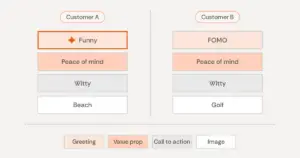
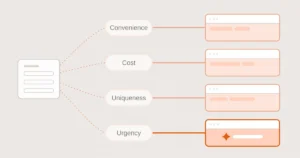
The same division applies once agents enter. The marketer owns the destination and the bounds, and the agent owns the tactics of getting there, which is the part no team could hand-write for every customer anyway. At Aampe by MoEngage that means an agent for every end user of a business, learning about that person and communicating with them through the tools a team already runs. What remains with people is strategic guidance and governance, plus the creative management of the patterns that emerge when many agents act at once and the job of bringing in knowledge from outside the system. There is more of that work than ever, and it sits a level above the mundane, tightly controlled tactics.
Brand consistency was an aspiration all along
Brand consistency is the usual place where the worry about control concentrates, and it is a notoriously hard problem even before agents enter. A single campaign passes through marketing operations, which orchestrates the emails, a data team keeping data flowing, and a design and brand team choosing images and taglines, often inside a tool like Figma. VPs of marketing at larger legacy businesses describe up to two to three months to release one new campaign, because of the handoffs between those groups. Consistency in that setup works as an aspiration.
Treating it as a standard to protect from loss frames the problem backwards. A business afraid of getting worse than it is today is aiming at the wrong target while its competitors are set to get a lot better, and the more useful question is how much better it can get. Agents can work across design systems more fluidly. Aampe integrates with Figma, so designers design there and agents pull those designs, while marketing and copy teams generate many possible versions inside brand guidelines that can reach customers as part of an ordinary daily message.
Measurement has to get as specific as the personalization
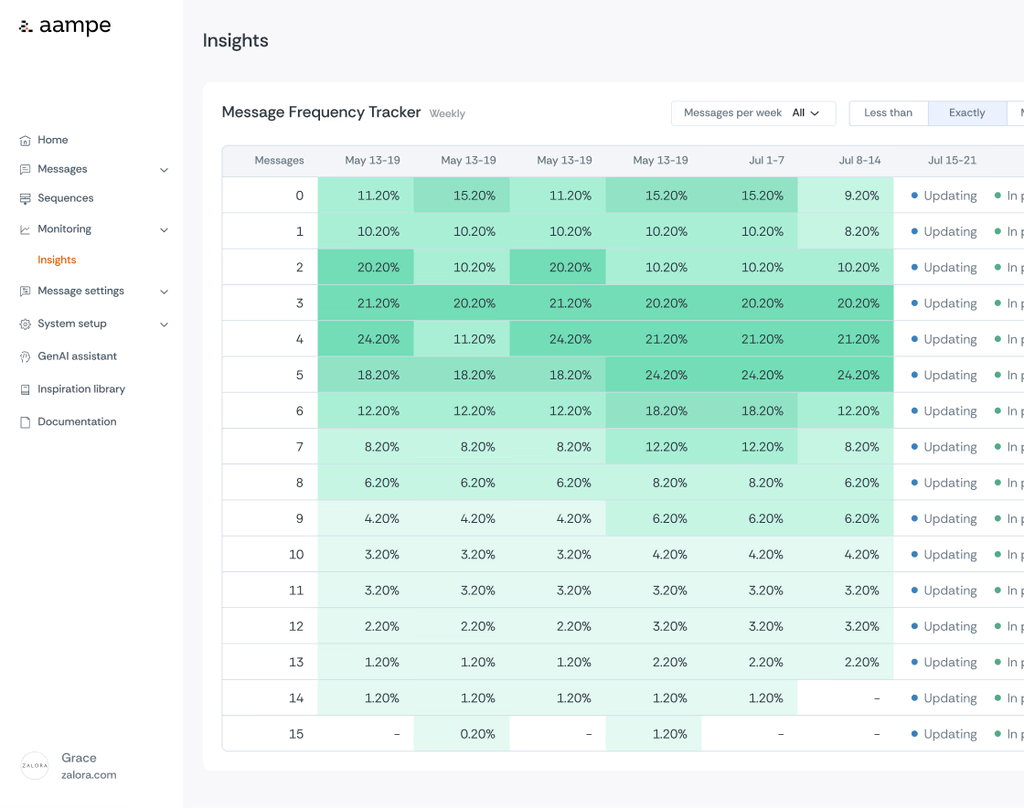
Most marketing teams still measure at the level of the campaign: a single email sent to a million people over the course of a week, judged by its average effectiveness. That level of measurement cannot support one-to-one work. More efficacy comes from more precision, which means measuring counterfactuals and controls, and measuring incrementality for the individual user and the individual message. Agents take on that measurement task as well, so the strategic marketing manager can calibrate the system with a much sharper read.
A film judged only on whether people liked it hides which scene, which actor, or which lighting choice did the work, and campaign averages hide the same things. The scene-level view in marketing is a reading of how a message works for a narrow set of users and ultimately for one person. Handing over execution becomes far easier to justify once the measurement can say what changed for a single customer because of a single message.
This builds on an episode of The Agile Brand with host Greg Kihlstrom, featuring Paul Meinshausen, CEO and Co-Founder of Aampe by MoEngage.