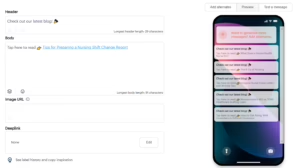
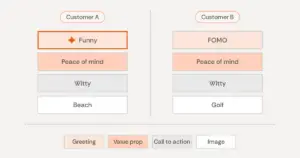
A push notification for a travel brand has three parts that most teams write as one: a greeting in the header, a value proposition in the body, and a call to action underneath. Write it once and it goes to everyone. Write it as separate pieces and something else becomes possible, because a greeting can now be funny, professional, or built on the fear of missing out, and each of those is something a system can learn about a person.
The reason this matters is a familiar pair of dead ends. A human team cannot write enough variants for hundreds of thousands of customers, and no marketer has the hours to talk one to one with that many people. Handing the job to a generative model with a prompt solves the volume and gives up the control, since nothing guarantees what comes back stays on brand. Each answer fixes one half of the problem by breaking the other half.
Content has to be taken apart before an agent can use it
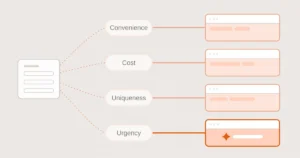
Start with a marketer who has an idea, say encouraging customers to browse summer vacation destinations. The generation step for this kind of system looks different from a prompt typed into a chat window. It produces the message as separate components, and each component comes back in several tones: funny, professional, FOMO. Several greetings, several value propositions, several calls to action, each tagged with a label that says what it is. Images can carry labels too, beach versus nightlife versus golf for a travel brand. The marketer reviews and approves the pieces before any of them can reach a customer.
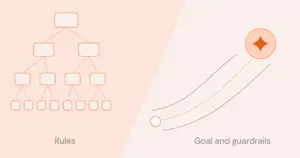
The arithmetic gets large fast. Six greetings, six value propositions, and three calls to action, with a few images in the mix, already produce 324 distinct messages. Routing those combinations to the right people by hand would mean writing rules until there is roughly one per customer, and no team keeps that logic current.
What an agent learns from a single send
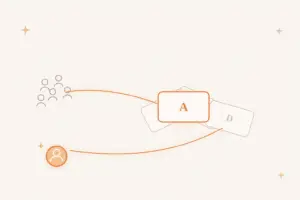
Every customer gets an agent of their own, so a brand with 500,000 customers runs 500,000 agents. Each one has a single job: learn what one person responds to, then adapt that person’s experience. This is the structure of Aampe by MoEngage, a learning layer built around the individual customer instead of the campaign.
When a message goes out, the labels inside it are scored on that customer’s profile, and the agent watches what the customer does next. A positive reaction raises its confidence that a funny tone works for this person. A negative reaction raises its confidence that a formal tone does not. Repeated across many labels and many sends, the profile turns into a map of one individual’s preferences. As a pattern firms up, the agent leans on the tone that keeps working and keeps testing the alternatives.
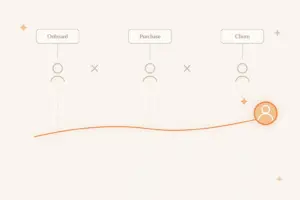
Attribution happens at the level of labels. A click, or a signal deeper in the funnel like a conversion that happens afterward, is credited to each label inside the message, with the message as a whole getting no single verdict. A send with a funny voice, a peace-of-mind value proposition, and a witty call to action teaches the agent three separate things about that customer. A campaign-level setup answers a different question, which message works best for the welcome series across a segment, and the individual gets averaged out of the answer.
More labeled variants give the agent more to learn from, and more chances to see whether a customer clicks or reacts further down the funnel. Brands are encouraged to build out as many labeled variants as they are comfortable approving.
The human decides what can go out
A common first assumption is that generative content will fly out the door without anyone signing off, and the design rules that out. Agents choose among pieces a person has already approved, so the combinations vary from customer to customer while every piece stays within brand guidelines. The labels carry the guardrails, and the agent works inside them.
The marketer’s role moves up a level. The work becomes bringing the idea, choosing the labels, and approving the pieces, while the decisions about who receives what, when, and on which channel pass to the agents. Control sits where it has leverage, in the content and the constraints around it.
The brand writes the pieces, and each customer’s agent decides how they fit together.
This builds on an episode of One Amazing Thing with host Greg Kihlstrom, featuring Zach Dorner, Lead, Solutions Consulting. Watch the full episode.