A commuter whose car now drives itself gets the commute back. The time fills up anyway, with emails, documents and slides. Efficiency frees time so the next task can start, and agentic marketing is about to run that experiment on every team whose agents take over campaign execution.
Those teams get back the hours that went into building journeys and approving sends. The open question is what the team is for once those hours are free.
The benchmark is everything else a customer could do
Agentic marketing leaves the purpose of a marketing team unchanged. It is the same job at a higher level of sophistication. A football player’s purpose is the same in high school and in the NFL, just executed far better.
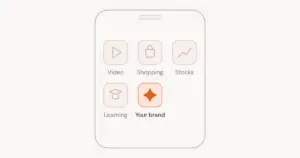
The point of comparison has moved. Customers do not care what the business did five or ten years ago or how it did last year. They compare it with whatever else could have their minute: a video, a clothes shop, a stock-picking app, an educational app. The test is whether another service gives a more direct and relevant experience than yours does today.
Why the baseline keeps rising
Any tool that relieves a team’s workload relieves its competitors’ too, so it sets a new baseline and offers no escape. The old five-year plan also did a quiet job for leaders. It let them switch off the planning part of their brain and just do the daily work. That rest has gone, because the plan now changes all the time.
Success is also forgotten quickly. A sale this week rings the bell. If that customer has not come back three months later, the sale is forgotten. Projects follow the same pattern: a launch works, and within weeks a senior executive asks what is next. Schaun Wheeler has written about why short-term metrics miss what adaptive systems do. The three-month gap is a plain example.
A book by a former 49ers coach, The Score Takes Care of Itself, offers a remedy. Run the practice in front of you, respond to what you cannot control, and plan for winning as well as failing. Teams tend to make their projects failure-proof and then have nothing ready for success.
Where the brand shows up in agentic marketing
What it means to be a recognizable brand is changing. The version inherited from the Mad Men era and the early web is no longer valid, or even desirable. Every person is the center of their own story, and a brand is one character in it. The aim is to be a key character, one that understands that person’s story faster and responds more thoughtfully.
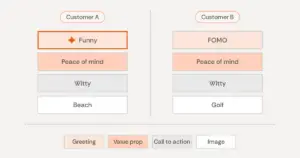
A character still has temperament. It can be the loud friend who does the crazy thing or the reliable friend who is always there. Those are strategic questions, and they stay with brand leaders and CMOs. They then show up through individual-level agents and individual agentic decisions. Paul’s first conversation with Greg covers what marketers still control when agents handle execution. Labeled content approved in advance is one way the brand’s choices carry down to each of those decisions.
Why change stalls
Leaders get further with small bets across the whole team than with heavy bets on marketing automation or on creative. Copywriters, operations specialists and designers each sit somewhere on their own curve of innovation. In agentic marketing, tools should let a win in one corner carry over to colleagues, because a win that stays isolated is weaker.
When a team resists, the cause varies. The book Tribal Leadership offers a framework of five levels of readiness for sorting it out. Some people are locked in fear. Others are fine individually but stuck behind a key stakeholder. Some mid-level leaders are neither afraid nor blocked, but legacy tools hold them back. Those tools work against each other or reward the wrong behavior. No single recipe covers all three, and a blog post cannot supply one. It is an assessment the team updates as things change.
Back in the car
In agentic marketing, the hours agents give back are free, and what fills them is a decision. Agents take the volume of campaign execution. The team decides what the next thing is and who the brand is for each person. It also has to keep pace with a baseline that keeps rising.
This builds on an episode of The Agile Brand with host Greg Kihlstrom, featuring Paul Meinshausen, CEO and Co-Founder of Aampe by MoEngage. More conversations like this are on our YouTube channel.