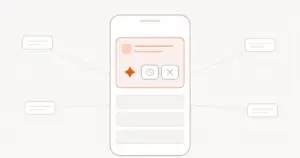
Someone taps the same notification three times in a week. They’re checking whether it’s the same message again, and they get a little more annoyed each time. To the agent behind that message, each tap looks like a small yes. Negative feedback only helps if it reaches the agent as a signal. The agent also has to treat it with the weight it deserves.
That gap between what a person feels and what a system can see comes up again and again. It limits what an agent can learn from people who are drifting away. Those are often the people a team most wants to keep.
What an agent can actually see
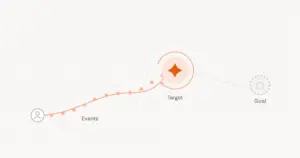
Agents learn from behaviour, not from feelings. Agents learn only from what they can see, and what they see is the event stream: opens, visits, searches, items added, purchases. Each agent compares what its user did in the short window after a message against what they would likely have done anyway.
Some events in that stream point the other way. Unsubscribes, push opt-outs, items removed from a cart and long silences are all negative feedback. The agent can only act on them if they arrive as events and the scoring treats them as harm.
Score negative feedback as harm
There is a quiet trap in how events get weighted. A common approach rates each event by how often it comes before the outcome a team wants, such as a purchase. That works well for positive steps and badly for harm.
A few people unsubscribe and still buy something later. Rated that way, an unsubscribe looks nearly harmless, because a purchase follows it a little of the time. Meanwhile, a purchase often follows removing an item from a cart, since people tidy their cart before checking out. So the milder signal ends up looking far worse than the serious one, in some cases dozens of times worse.
The fix is to give clear negative feedback, like an unsubscribe or an opt-out, a fixed and strong negative weight. That weight should not depend on how often it happens to come before a sale. The agent then learns to avoid what pushes people away, and the scoring no longer depends on a statistical accident.
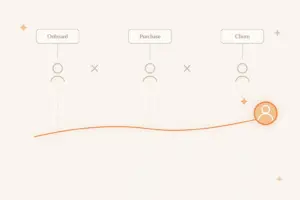
A line of events running from harm to goal. Unsubscribe and opt-out sit at the harm end, removing an item from a cart sits just short of neutral, and opening the app, adding to cart and purchase sit toward the goal end. The orange star marks the unsubscribe as a clear negative feedback signal.
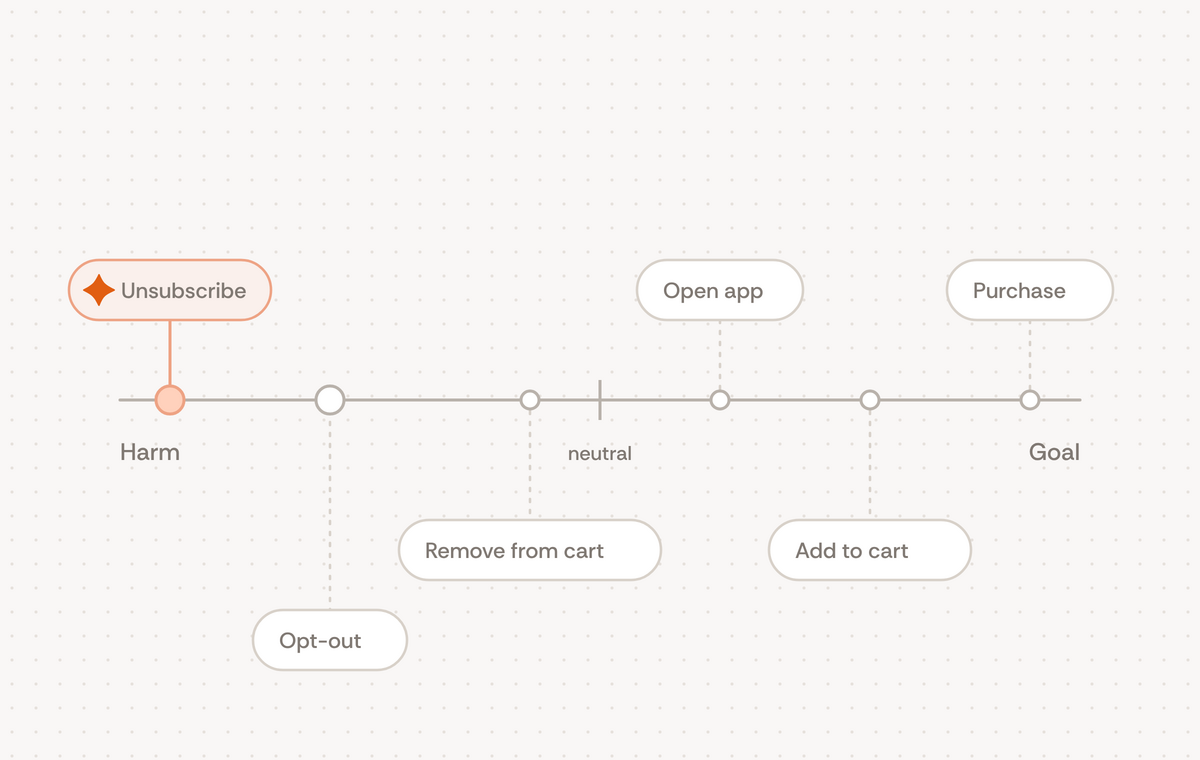
Clear negative feedback gets a fixed, heavy weight. Milder signals sit closer to the middle.
Let people say no in more than one way
Many apps give people only two choices: engage or unsubscribe. Everything in between disappears. An annoyed tap reads as interest, and a quiet “not now” looks the same as “never.”
Small controls change that. Buttons like “not interested,” “remind me later” or a thumbs down give each person a way to send negative feedback without leaving entirely. Each one tells the agent something specific. “Not interested” says this topic isn’t landing. “Remind me later” says the idea may be fine but the moment isn’t. Each signal costs the user a single tap and gives the agent something specific to learn from.
What the agent does with a no
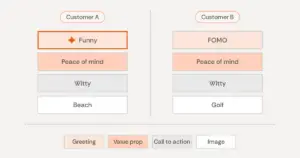
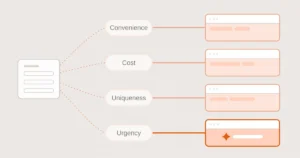
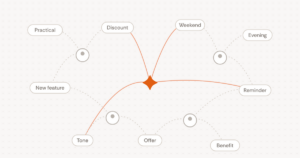
Negative feedback changes what the agent tries next, without ending the relationship. The agent might switch to a different value proposition, try another channel or time, or send less. It keeps exploring, because a person who said no to one kind of message may still say yes to another.
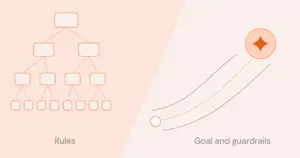
Teams stay in charge of the rules. They decide which events count as goals, which don’t matter and which count as harm. The agents then work person by person inside those definitions. Getting the negative side right lets agents learn from people who are quietly moving away. Without it, they mostly learn from people who are already happy.
There is a short video on how AI agents measure a “win”, and more conversations like this are on our YouTube channel. Schaun Wheeler writes regularly about how agents learn from events.