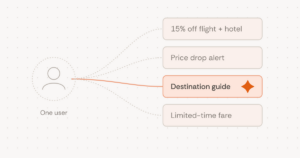
A push notification offers 15 percent off a flight and hotel in Ibiza. It lands on the phone of someone who is planning a family trip around a grandparent’s ninetieth birthday. The price is good and the offer is real. Nothing in it helps that person picture the trip they are planning. Travel push notifications are full of messages like this one.
A run with a travel aggregator shows what happens when each user has an agent that learns what moves them.
Why teams aim at opens and clicks
The travel aggregator lets people book flights, hotels, car rentals and other travel activities in one app. It came to Aampe wanting more app opens, with push notifications as the lever. That goal is common. CRM teams usually own the top of the funnel. The business measures them on clicks and opens, even though it judges itself on purchases and revenue. The working assumption is that once someone reaches the app, the rest takes care of itself.
Travel stretches that assumption. It is a seasonal business, and people go in summer or over the holidays. Although there may be people who book three trips a week the way they might reorder food (I’m very jealous of this person, believe me), they’re probably not in the majority. A push notification does not make anyone decide to travel. In travel push notifications, teams watch opens and clicks because those are the numbers a push can report.
What agents picked up in travel push notifications
Promotion-led travel push notifications have thus become the default. Teams send a lot of promotions and hope the discount pushes users to book. What surprised the travel aggregator was that the agents picked up non-promotional content, such as destination guides and blog posts. That content helps users imagine themselves at a destination, which 10, 15 or 20 dollars off a flight does not do.
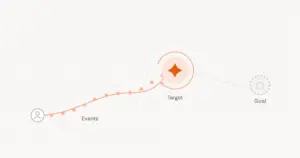
Each agent was also learning what kind of value its user wanted from travel. That question had not been on the team’s radar. The team came in to move app opens, and clicks are the closest stand-in a push can report. Clicks rose 3 percent over baseline, and conversions rose 15 percent.
Attribution assumes something already influenced the purchase. The harder question is what does influence it, and the answer starts with knowing the user. Sometimes that means sending fewer messages to someone who would rather be left alone.
Why this content is hard to write
Writing non-promotional travel push notifications forces a team to think about its users. What do they care about, what moves them, and why are they traveling at all? Someone who lives far from family may travel mostly to spend time with people they love. Someone with young children needs something kid friendly. A 15 percent discount on a flight and hotel answers neither need.
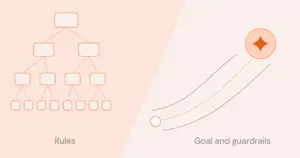
The habits CRM teams built over the years point somewhere else. They learned to find the best average time to send a message, to run A/B tests to statistical significance and to optimize clicks. Working out who the user is and what value they want from the product is a different skill, and teams are now retraining for it.
How labels give agents something to learn from
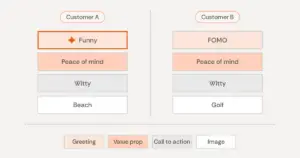
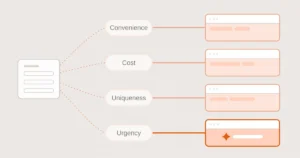
Behind agent learning sits a semantic layer, a set of labels that represent users and what resonates with them. Every piece of content carries labels, for example one for travelers who want comfort and another for tropical destinations. Agents learn at the label. A message can be worded many ways, and the wording is not the essence.
That is why teams start from user motivations and then attach labels to the content they write. The aggregator pushed its label taxonomy across many different hypotheses about what might move travelers. Early on, a person labeled every snippet by hand. Now a team can write a whole message, or have an agent write many. An LLM applies the labels, so the learning is preserved. The goal is content that resonates with each individual, and labels make it practical to produce the variations that learning at that scale needs from a large, varied message inventory.
How to measure it without last click
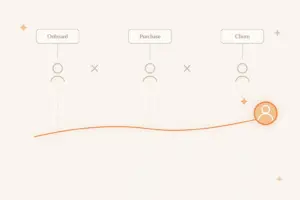
Last-click attribution fits a world where everyone gets the same message and the team checks who clicked, then who bought. Aampe has argued elsewhere that attribution at the aggregate level asks the wrong question. Agent-led messaging also changes the strategy itself. A message may carry no call to action. A run of three or four messages over two weeks may lead someone to start thinking about a destination, slowly imagine themselves there and finally click. The count of travel push notifications sent, opened and clicked stops meaning much.
The business still wants proof, and agents carry a cost. The rule of thumb is to take the whole user population and split it into cohorts. Some cohorts keep the classic CRM strategy and some move to the agent-led one. Then measure uplift on average order value or customer lifetime value instead of last-click attribution. The difference between cohorts is incremental value, and the team can put a dollar figure on it.
From there the calculation runs backwards. Subtract the cost of running agents from that revenue and the result shows how many multiples of return the business gets. Thresholds differ by business and depend on cancellations, returns, how stable the business is and, for a subscription app, retention.
The hard part is unlearning
The most important thing a team brings is an open mind and a willingness to experiment. A change in process is painful, because people have built expectations around exactly how the old system behaves. Teams have to unlearn some of it, and unlearning is harder than learning. It is a slow process.
Agents can learn what moves each person. The team still has to bring a clear sense of its customers and content worth learning from. Somebody has to know that the traveler planning the ninetieth birthday exists, and write something for them.
This builds on a conversation between Patricia Lazatin and Sami Abboud, CTO and co-founder of Aampe by MoEngage, in the first episode of AI Decisioning: Notes from the Field. More conversations like this are on our YouTube channel.