What do the most personalized digital experiences in the world actually have in common?
Think about Netflix’s “Top Picks For You” section.
Think about Spotify’s “Discover Weekly” playlist.
They don’t just have a lot of content. They have structure.
More specifically, they’ve built deep semantic layers: thoughtfully designed labeling systems that describe content in ways machines can reason about and humans implicitly respond to.
Need some examples?
Netflix doesn’t just have Comedies. It has dark comedies, satirical comedies, romantic comedies, teen comedies, mockumentaries, political satires, horror comedies, anime comedies—and dozens more.
Spotify doesn’t just have EDM. It has ambient dub techno, dark minimal techno, Nordic house, progressive psytrance, Uk garage, chillwave, genres so specific that even your hippest, most music-obsessed friend might struggle to explain the difference.
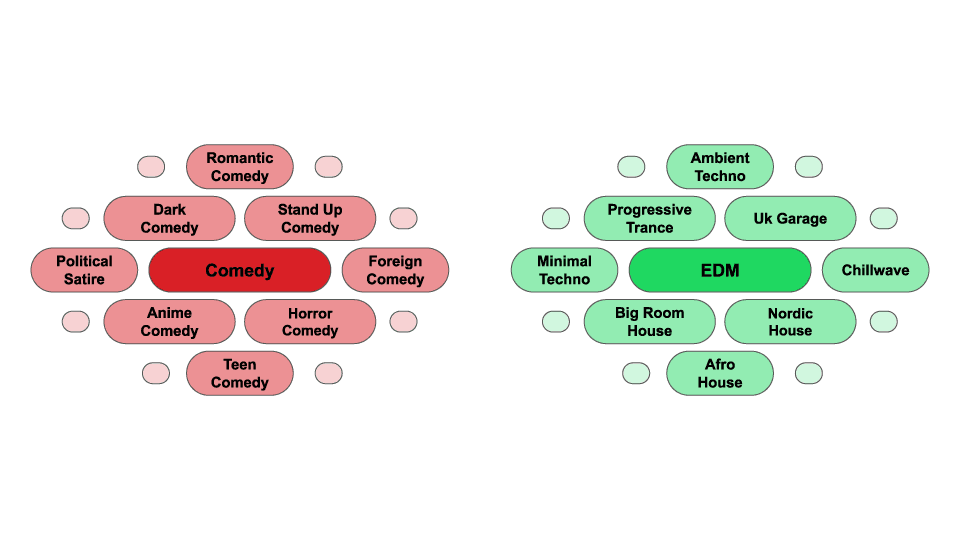
Those labels aren’t decoration. They’re the foundation that makes personalization work.
To understand why, take a second and imagine Netflix without them.
You finish watching American Psycho. An unlabeled system sees only a few coarse signals: it’s popular, and it’s categorized as a comedy. So it recommends Despicable Me next.
That recommendation feels absurd. But without labels, it isn’t obviously wrong. It’s a next best recommendation based on a surface-level similarity (comedy) and group averages (what’s popular with most people).
But you’re not “most people.”
You didn’t enjoy American Psycho because it was broadly funny or popular. You enjoyed it because the humor was dark and satirical, and the tone was unsettling and psychological.
With those labels in place, the recommendation shifts from Despicable Me to Fight Club, not because the movies are identical, but because they share the more nuanced underlying themes that actually drove the original choice.
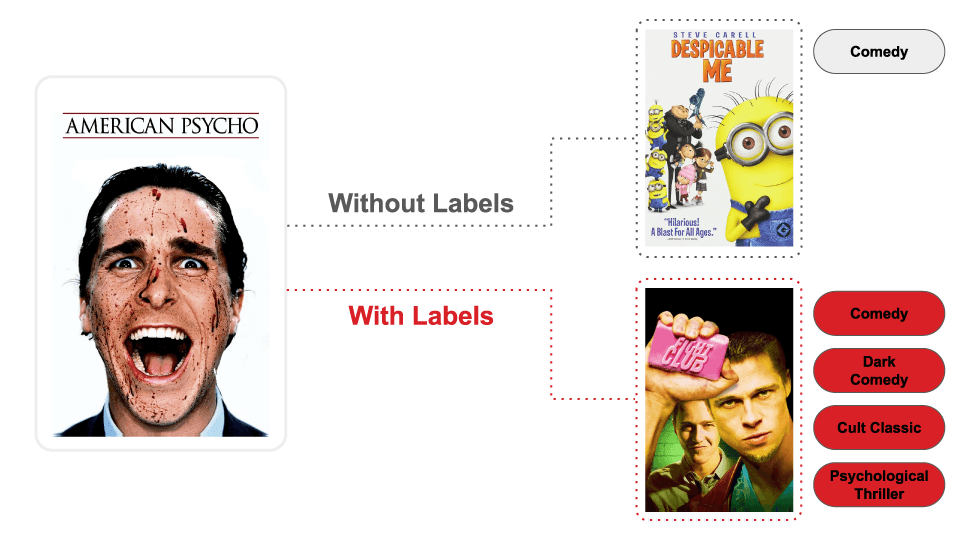
That’s the difference labels make.
They prevent systems from optimizing on surface-level categories and averages, and instead allow them to align with why an individual engaged in the first place.
That isn’t accidental. It’s foundational.
The Semantic Layer: Giving Agents Something to Reason With
In Aampe, all content is structured and labeled.
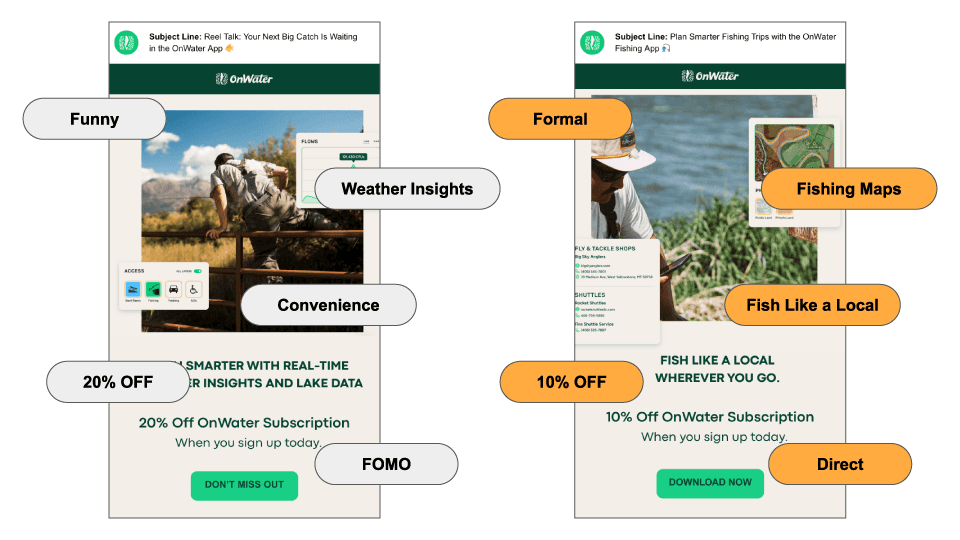
An email subject line might be labeled Funny or Formal. A value proposition in a push might be labeled Convenience, Community, or Trust. A CTA might be labeled Direct or FOMO.
Tone, framing, incentive strength, timing, channel, everything can be part of the semantic layer.
These labels aren’t cosmetic. They are the primitives agents learn on.
Instead of asking, “Did Message Variant A beat Message Variant B?”, Aampe decisioning agents can ask more powerful questions:
“For this user, do messages about our Community value proposition tend to resonate better than messages about Convenience?”
“Does content with a Funny tone tend to drive more clicks than content with a Formal one?
“Does this user convert more often with 20% Off offers, or does a 15% Off or even a 10% off offer work just as well?”
Why Labels Matter More Than You Think
1. Cleaner Experimentation and Faster Learning
Without labels, outcomes are ambiguous.
Push Variant B performed better... but why?
Was it the tone? The value proposition? The incentive? The timing? The channel?
You get attribution, but it’s muddy.
With labels, agents can isolate what changed.
When the value proposition in your messaging shifts from Cost Savings to Time Savings, and engagement increases, the system knows why.
Learning is clean, cumulative, and reusable.
2. Learning Transfers Across Messages, Channels and Lifecycle Stages
Without labels, learnings are trapped inside individual campaigns.
Intelligence resets with every new campaign or use case.
With labels, agents can generalize learnings across contexts.
If a user responds well to your Convenience Value Proposition in one context, the agent can try Convenience elsewhere: different channel, different offer, different lifecycle stage, etc.
User behavior from onboarding informs retention, retention behavior informs monetization, etc.
Learning carries forward instead of resetting.
3. Deeper, Explainable Customer Insights
Without labels, reporting tells you what won.
Insights are of little value outside the context of the campaign: “Message Variant B Won”
With labels, reporting tells you why you won.
Explainable insights, not black-box winners
“When we shifted the value proposition from Convenience to Affordability, conversions increased.”
These insights can even inform decisions across the entire business:
Social Media - “Cheeky humor wins on our owned channels. Double down on this tone on X to capture more attention.”
Paid Media Strategy - “Our Gen Z Audience is resonating the most with our “Try Before You Buy” Value Proposition. Target them with this same content in our Meta Campaigns”
Product Strategy - “Our audience’s preferences are shifting towards more Healthy Lifestyle content. Let’s invest in creating Sugar Free versions of these SKUs for them”
From Outcomes to Understanding
Unlabeled copy tells you what worked once.
Labeled content teaches your system how to work again, and again, for every user, across countless moments.
That shift, from optimizing isolated outcomes to building durable understanding, is what makes agentic personalization possible at scale.
Netflix and Spotify figured this out years ago. They didn’t just build better algorithms. They built semantic foundations those algorithms could learn on top of.
At Aampe, we believe the same is true for marketing and product experiences.
If you want systems that can reason, adapt, and align with individuals over time, you don’t start with models.
You start with meaning.