A customer once added a brand-new promotional labels to a batch of messages. A week later they asked why the agents hardly sent them, though nothing had gone wrong. The agents had evidence about the older message labels and none about the new one. So they tried it cautiously while they learned. The answer to the question sat in how the labels were built.
Back in 2022, Schaun Wheeler wrote about structuring an app’s inventory so a system can learn what each person responds to. His example was a home goods customer with 283 different paths to over 250,000 items. After Aampe reduced those paths to nested categories, a response to lamp shades also taught the system something about lighting. That principle still holds, while the unit of learning has changed. Today every user has an agent, and the agent learns through the labels on each part of a message.
Message labels are hypotheses
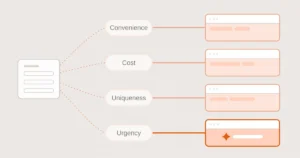
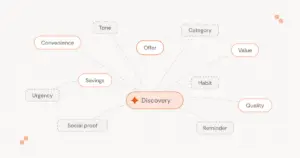
A label names a reason someone might act, such as an offer, a tone or a product category. Each one is a guess about motivation, and the agent tests that guess one user at a time. So the first design question is whether a label describes what a person prefers or the situation they happen to be in.
Agents learn from a label by using it again and again and watching how a person responds each time. That works for preferences, which tend to stay put, so every send adds evidence about the same person. Circumstances, like having just changed a plan or reaching a renewal date, pass. A label built around one teaches the agent noise, because the moment ends and the label stays. It can even lead an agent to treat someone as interested after they have already done the thing. Circumstances work better as eligibility rules and triggers, which decide when a message is relevant. Message labels then carry the preferences the agent is learning.
Fewer, broader labels with a catalog underneath
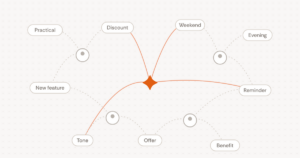
Large catalogs tempt teams to mirror every category as a label. On one account, a few dozen proposed category labels turned out to be mostly subcategories. The team rolled them up into about ten broader labels. A recommender drawing on the product catalog then filled in the specific items.
The split matters because each part does a different job. The agent learns which broad kind of thing interests a person through the labels. The recommender handles specific items, so the agent skips learning every small distinction by trial and error. It is the same idea as Schaun’s nested categories, applied to a system where every user has an agent.
Reuse message labels so learning carries forward
A new label starts from zero, which is what happened to that promotional label. Starting from zero once is fine, but not when every short promotion gets its own label. None of those labels lives long enough to collect evidence. For one team running frequent short promotions, our advice was a single reusable label for whether a promotion is on. The details of each offer can sit elsewhere.
The agents still keep exploring new options while they lean on what works. Evidence only builds up on labels that come back again and again, though, so reuse is what lets learning compound.
A diagram about message labels. On the left, seven one-off promotion labels, each attached to a single message with almost no evidence behind it. On the right, a few reusable message labels, each with several versions of copy, and a growing bar of evidence beside each label. One label holds the orange star.
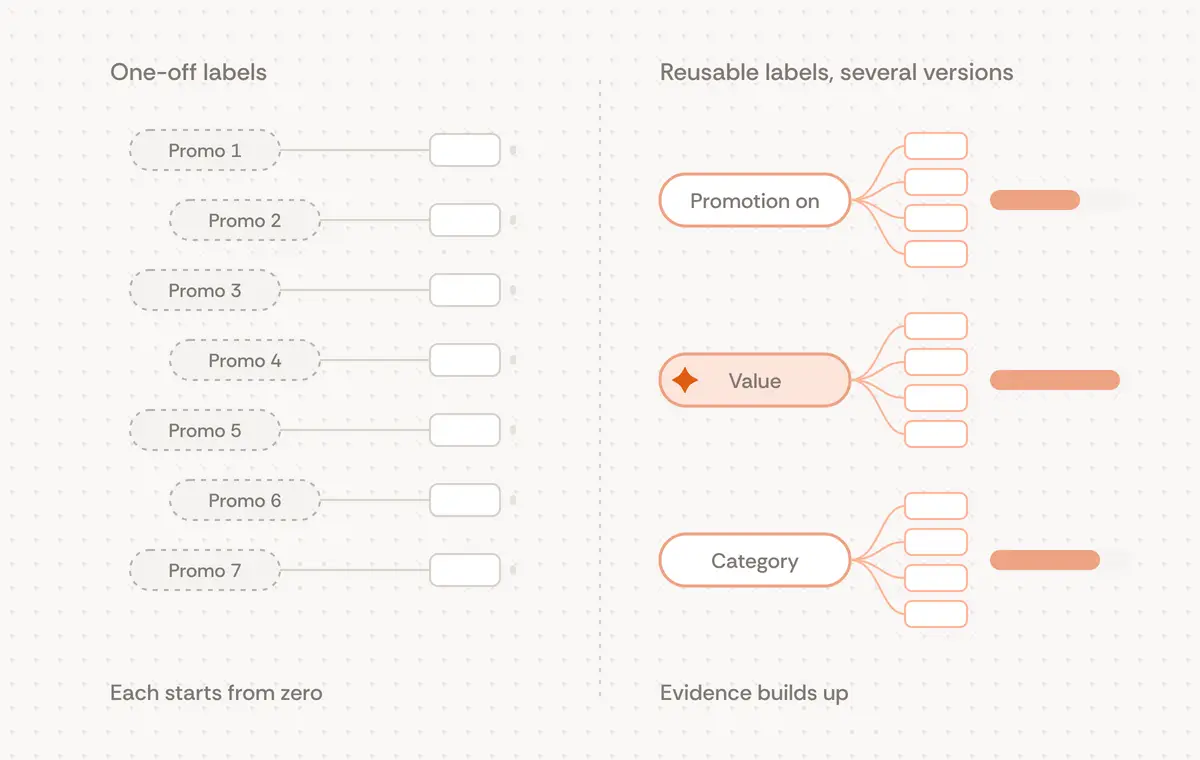
One-off labels start from zero every time. Reusable message labels with several versions build up evidence the agents can use.
Give every label more than one version
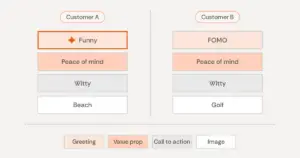
An audit at one account found around two hundred labels with one version each. It also found many pairs of near-duplicate copy. With one version, an agent cannot tell whether a person responded to the label’s idea or to one particular sentence. Our standing advice has been at least three versions per label, and no repeated components.
This is also where labels pay off for the people writing content. Because labeled components recombine, a modest set of versions produces many messages. Relay helps teams build and evaluate that kind of structured, labeled content, with people still setting direction.
Where this is heading
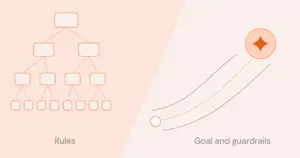
Schaun has written publicly about the next step. Agents will depend less on hand-built taxonomies and more on finding the relevant dimensions on their own. Until that work lands, message labels remain one of the strongest levers a team controls. Treat each one as a hypothesis about what moves a person. Then build it so the evidence has somewhere to accumulate.
This updates Schaun Wheeler‘s “Structure app inventory for message-led personalization” from 2022. Details from customer accounts have been removed to keep them anonymous.
Schaun walks through how to categorize content for AI agents in a recent video, and more conversations like this are on our YouTube channel