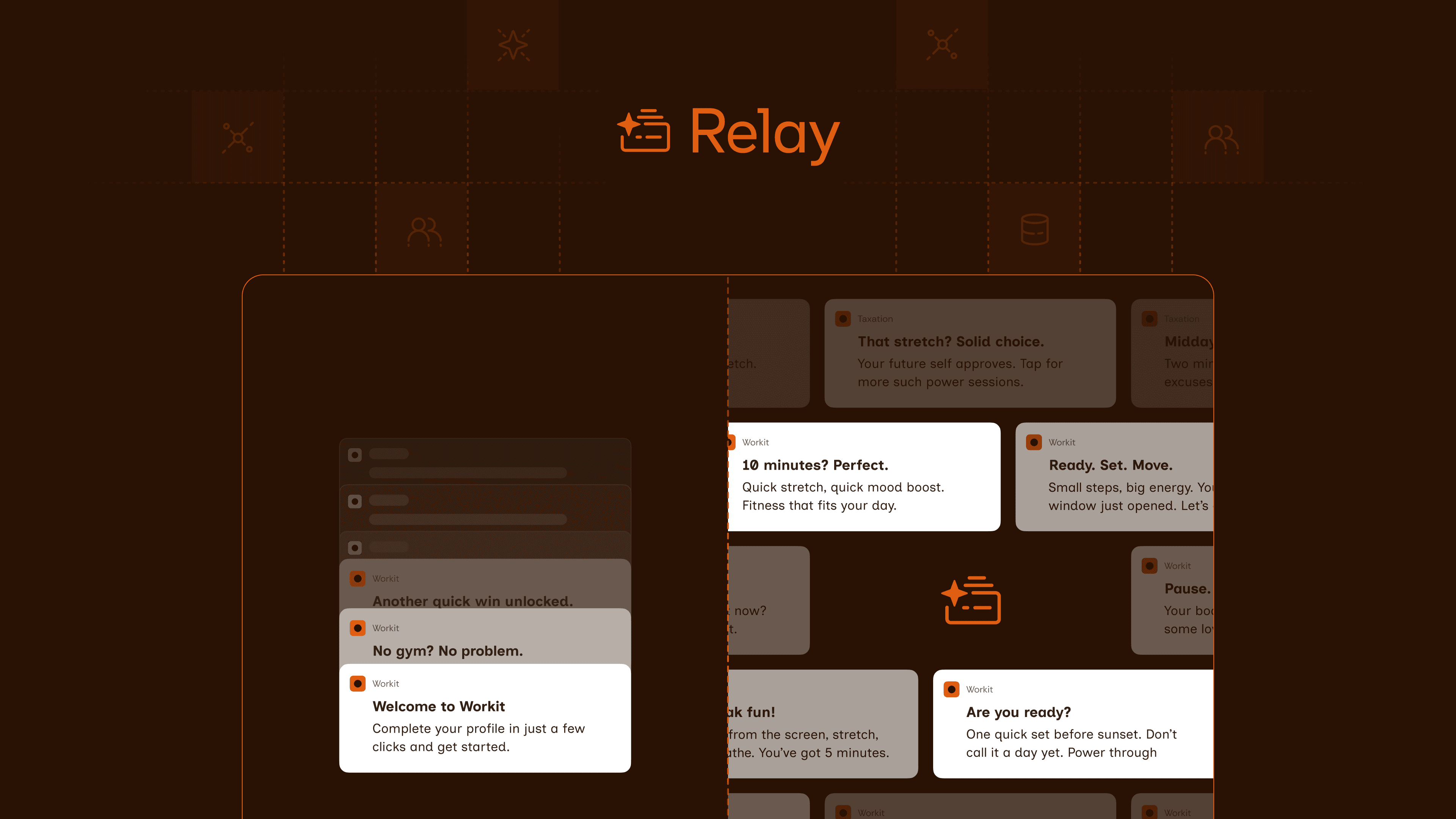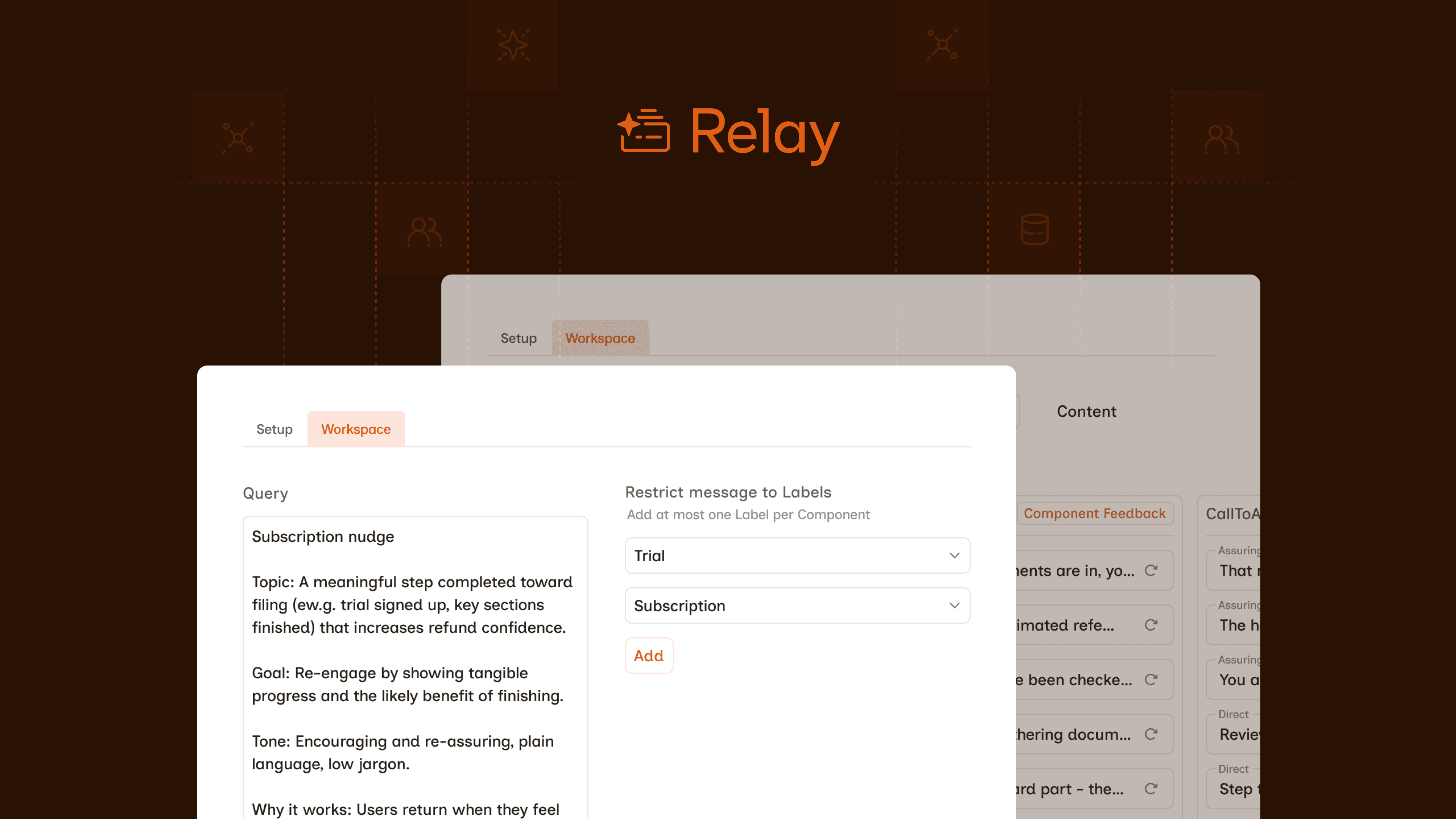
Today, we’re excited to introduce Relay — a new content generation system built for a world where AI systems — not just humans — shape marketing outcomes
Marketing teams today don’t struggle because they can’t write good content. They struggle because the amount of content required has exploded. Every channel, every user moment, and every experiment now requires specific, contextual language that AI systems — not just humans — can reason about.
Yet most teams are still writing, reviewing, and approving content as finished assets, one message at a time.
Relay exists to change that.
Why We Built Relay
Marketing has outgrown the asset-based model of content.
As AI-driven systems take on more marketing decision-making and personalization power, the content systems marketers build on must change with them.
Lifecycle programs span hundreds and thousands of possible touchpoints. Product launches need to show up consistently across surfaces. Growth teams need enough variants to actually learn what resonates. And personalization demands more than one “best” template.
At the same time, marketing decision-making is becoming increasingly agentic — with systems deciding what to say, to whom, and when.
But the systems content was built on haven’t kept up.
Even when teams use AI tools, the workflow still looks the same:
Write prompts
Generate text
Copy-paste outputs
Start over for the next request
Every generation is a reset. There’s no structure, no memory, and no way to learn systematically.
Relay was built to replace that model with something fundamentally different.
What Relay Is
Relay helps marketers design, produce, and evaluate creative content systems at scale — so teams can experiment, learn, and improve how they connect with users across every moment.
It’s not just a copy generator. Relay treats content as infrastructure.
That means content is:
Structured, not free-form
Reusable, not one-off
Designed for evaluation, not manual line-by-line review
Built to improve over time, not reset with every prompt
Relay is designed for a world where agents deliver personalization, and content needs to behave more like software than static assets.
How Relay Works
1. Bring your brand and context
Relay starts with what makes your brand your brand: voice and tone, product details, legal constraints, and the outcomes you’re trying to drive — like activation, retention, or feature adoption.
2. Choose what you’re creating
Teams select a message type or component set — such as value props and distinct product features or catalogue offerings, onboarding nudges, or win-back moments — and the channels where the content will live (push, email, in-app, ads, and more).
3. Generate structured content at scale
Relay produces a structured set of content variations aligned to your goal — fast. Teams start with real options, not a blank page.
4. Guide with feedback, not rewrites
Instead of rewriting prompts from scratch, teams give clear feedback on direction:
“More playful” or “more direct”
“Add urgency” or “avoid discounts”
“These CTAs feel generic — make them more specific”
Relay updates its generation strategy and regenerates accordingly.
5. Evaluate, don’t manually review
At scale, reviewing every message doesn’t work. Relay supports sampling and evaluation — helping teams confirm that content aligns with guardrails, intent, and quality without approving every variant individually.
6. Reuse, export, and improve
Because content is structured and labeled, it can be intelligently reused across, channels and different users’ lifecycles. As outcomes are evaluated, teams refine direction — and future output improves without starting over.
What Teams Use Relay For
Relay is already being used across a wide range of marketing workflows:
Lifecycle messaging at scale
Onboarding, activation, retention, and win-back systems that don’t stall due to content limits.Experimentation and A/B testing
Enough meaningful variants to test ideas, structures, tones, and narratives — not just minor copy tweaks.Product and feature launches
Consistent, on-brand messaging across every surface without rewriting the same ideas repeatedly.Campaign production
Large campaign content sets produced quickly, with structure and control built in.
Reusable content librariesLabeled components — value props, CTAs, message building blocks — that compound in value over time.
What Makes Relay Different
Most AI tools focus on generating text. Relay focuses on operating systems.
With Relay:
Humans set direction, intent, and guardrails
The system handles variation and volume
Evaluation replaces manual review
Learning compounds instead of resetting
At scale, the bottleneck shifts from writing to ideas and creativity — where teams actually want to spend their time.
Why This Matters Now
Marketing is entering an agentic era.
Decisioning is becoming more autonomous, more contextual, and more personalized — driven by systems that operate at a pace and scale humans can’t manage alone.
In that world, content can’t be treated as fixed, finished assets. It has to behave like software: iterative, testable, and designed to improve over time.
Relay is built for that future.
Get Started with Relay
Relay is available now for teams ready to move beyond asset-based content workflows and start operating content as a system.
If your team is feeling the pressure of scale — or wants to experiment and learn faster without losing brand control — we’d love to show you what Relay can do.
Welcome to the next generation of marketing content.
👉 Book a demo to see Relay in action