Someone on a CRM team watches lapsed users start coming back and asks the obvious question: which segment did that? With per-user agents, there is no segment to point to. Each user’s agent made its own choices from what that one person responded to. Behavioural segmentation still has a job, but it moves from the start of the process to the end.
That shift comes up again and again. Teams ask for the segments the agents use, the groupings behind each decision, or a clean answer to why a number went up. The agents don’t work from segments, but a team can still build readable groups afterwards from what the agents learned.
Why there is no segment to hand over
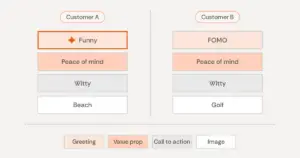
Every user starts somewhere. A brand-new user’s agent leans on what has worked across the whole user base. A user with a little history borrows from people who look similar. For a user with a long history, the agent relies mostly on that person’s own responses. Those comparisons happen in the moment, in the agent’s own terms, so they don’t sit in a table as named segments.
What each agent keeps is a picture of which labels move its user: the value proposition, the tone, the offer, the time of day. That picture is specific to one person. Folding it back into a handful of segments would throw away the variety the agents were built to protect. Our co-founder and chief scientist, Schaun Wheeler has argued that targeting by attributes falls short of learning from interaction, and per-user agents are that argument put into practice.
Build behavioural segmentation backwards
You can still group users. You just do it after the fact, from the agents’ learning rather than from a guess made in advance. Three views have worked well.
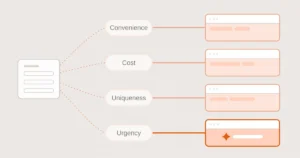
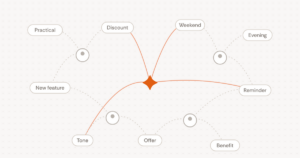
The first groups users by the labels they respond to. People who move for practical benefits sit together, as do people who move for discounts or for something new. That gives a CRM team a behavioural segmentation grounded in observed response, not in demographics.
The second starts from audiences a team already uses, such as new, active and lapsed users. It then compares which labels work in each. Most messaging tools can’t show this, because they only report how each campaign performed.
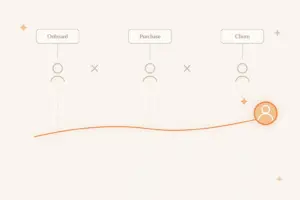
The third tracks how users move between lifecycle stages over time, split by the month they started. It shows whether people are moving forward, which is the question most teams actually care about.
Keep these views narrow. Show the few patterns that line up with the outcome you care about, rather than every label combination the agents have tried.
A diagram of behavioural segmentation read backwards. On the left, many individual users, each with their own small set of label preferences. Arrows lead to three simple groups on the right, labelled by what moves them: practical benefits, discounts and new things. The orange star sits on one user inside the practical benefits group.
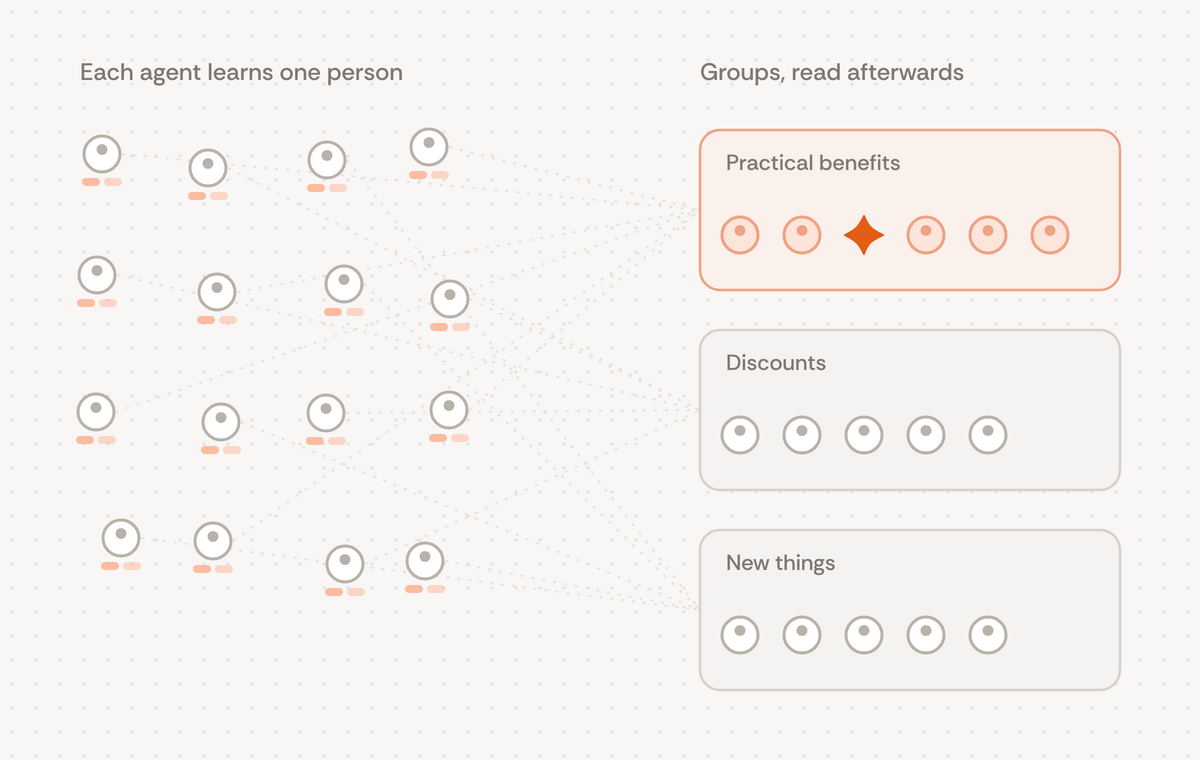
Each agent learns one person. Groups come afterwards, from what those agents learned.
Show people, not only percentages
Averages and even a good behavioural segmentation can hide what changed. A handful of real user timelines often explains more. One approach is to pick users with at least a month of history before and after the agents started, and with at least twice as many conversions afterwards. Then plot what happened to each of them, message by message.
Those timelines show the work the agents did. One user might respond to a reminder at the weekend, while another ignores discounts and comes back for a new feature. Nobody designed those paths in advance. Each agent found its user’s path by trying things and watching what changed.
This is also why auditing a single agent decision misses the point. The more useful questions are about patterns across many users and what the team can change, such as the content library or the goals.
Your existing segments still have a job
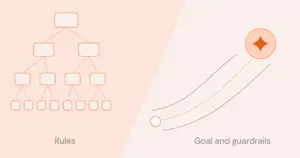
Fixed audiences remain useful. They work well as eligibility rules, as guardrails and as reporting lenses. Teams set those boundaries, and the agents work person by person inside them. The change is that behavioral segmentation stops being the thing that decides what each person receives. It becomes a way to read what the agents have learned and to decide where the team should invest next.
Schaun Wheeler goes deeper on why customer segmentation is the wrong starting point, and more conversations like this are on our YouTube channel.