Travel Intent Changes Quickly. Can Your Personalization Keep Up?
In January, a traveler is researching Japan.
In February, Fiji appears.
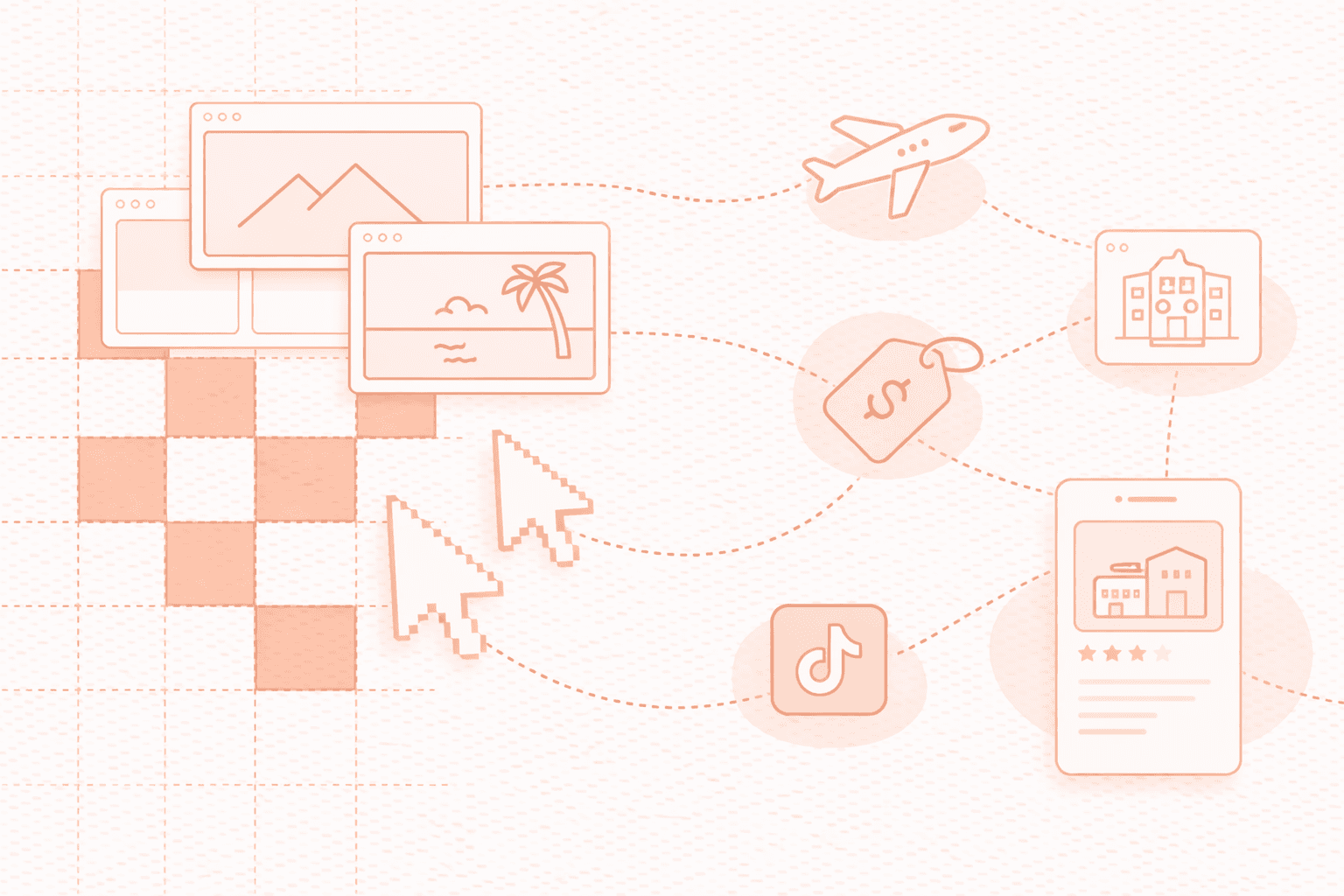
By March, Rome sneaks in because fares dropped, a friend sent a TikTok, and suddenly “maybe spring” becomes “definitely next month.”
On a dashboard, that journey can still look beautifully orderly: awareness, consideration, conversion.
In real life, it looks more like a browser with 27 tabs open and one very determined group chat.
That gap matters.
Because travel decisions rarely move in a straight line. Travelers bounce between destinations, switch priorities, compare formats, revisit old ideas, and act quickly when the right combination of price, timing, and convenience finally appears. At the same time, travel planning is increasingly shaped by digital discovery across social platforms and AI-assisted research, which makes intent even more fluid and harder to read through static lifecycle logic alone.
The journey map is neat. Travel behavior is not.
For years, marketers have relied on a familiar story: a customer enters the funnel, moves from inspiration to research to booking, and personalization helps nudge them forward.
That story is useful. It is also increasingly incomplete.
Deloitte notes that generative AI is already changing how travelers research and plan trips, with nearly a quarter of travelers reporting use of gen AI tools for trip planning in late 2025, about triple the level seen in 2022. The same report argues that these tools may reshape how decisions are made and reduce traditional brand touchpoints during consideration. Meanwhile, Expedia Group reports that more than 60% of travelers now turn to social media for inspiration, and 73% say influencer recommendations have affected booking decisions.
That means the “journey” is not just faster. It is more blended.
A traveler can be price sensitive and experience driven. They can be comparing two beaches and one city. They can be planning a family holiday and a work trip in the same month. They can be inspired on social, validate on search, ask AI to narrow the list, then book the option that happens to feel easiest in the moment.
The practical problem for marketers is simple: if intent changes this quickly, a system that updates slowly will always feel slightly late.
And in travel, slightly late is often too late.
Personalization is no longer a nice touch
As discovery becomes more fragmented, expectations for relevance go up.
Consumers increasingly expect brands to understand what they want without making them repeat themselves across every interaction. Deloitte Digital’s personalization research found that brands with stronger personalization maturity are more likely to exceed revenue goals and report improved customer loyalty. But it also found a gap between what brands think they are delivering and what customers actually perceive: surveyed consumers recognized only 43% of their experiences as personalized, while brands said they personalized 61% on average.
That is an uncomfortable number, and an important one.
Because it suggests that “we have personalization” and “customers experience us as relevant” are not the same thing.
In travel, that gap can widen quickly. Not because teams are doing poor work, but because the underlying customer context moves around faster than traditional campaign structures were designed to handle. A message can be well written, well timed according to the campaign calendar, and still wrong for the traveler who changed their mind on Tuesday.
Why personalization often plateaus
Most brands do not start with a personalization problem. They start with a personalization success story.
They improve segmentation. They build more journeys. They test more creative. They connect more channels. Performance goes up.
Then, eventually, it stops going up in the same way.
So teams do what smart teams do: they add more logic. More branches. More triggers. More variants. More exceptions for edge cases that, inconveniently, stop being edge cases.
The result is usually not a lack of sophistication. It is too much of the wrong kind.
Deloitte Digital describes personalization as a value exchange: relevance in return for loyalty. But relevance depends on more than inserting the right destination or offer into a message. It depends on whether the system can keep pace with changing customer needs, channel preferences, and decision context. Their research argues that many brands still face a “connection gap” between customer strategy and actual end-user experience.
That is the plateau.
Not a creativity problem. Not a data problem. A learning problem.
Travel intent is dynamic because travel itself is dynamic
This is where travel behaves differently from many other categories.
The product is not just a product. It is timing, budget, availability, purpose, companions, flexibility, weather, confidence, and mood — all negotiating with each other in real time.
Deloitte’s travel outlook makes this especially clear in its discussion of AI-enabled shopping and dynamic offers: travel companies are moving toward more tailored add-ons, dynamic pricing, and merchandising based on context, timing, and traveler behavior. That language matters. Context, timing, and behavior are not static fields. They shift during the decision process itself.
So when marketers rely on fixed segments and predefined paths, they are often personalizing to a snapshot of intent rather than the live version of it.
That is a subtle difference on a slide.
It is a very expensive difference in market.
More output is not the same as better understanding
This is also why the current wave of AI enthusiasm deserves a small reality check.
Yes, AI can help marketers move faster. It can generate more copy, support more experimentation, and make large-scale execution easier.
But more output does not automatically produce better personalization.
Aampe’s public writing on personalization makes this distinction clearly: recommendation problems and messaging problems are different, and user preferences around copy and context can shift quickly, which is why adaptive systems need recency-weighted learning rather than static assumptions. In a separate post, Aampe argues that personalization breaks down when it is built on frozen logic while the user continues to change.
That is especially relevant in travel.
If a system still assumes the traveler researching Japan last week is fundamentally the same traveler today, it may produce more content while understanding less of what matters.
The issue is not whether AI is useful. It is whether the system is learning continuously enough to keep relevance alive.
The strategic advantage is adaptive relevance
Travel brands do not need more reminders that customer expectations are rising. They are already living it.
What matters now is whether personalization is built to adapt at the speed of intent, not just execute at the speed of production.
That is becoming more urgent as discovery behavior changes. Deloitte warns that travel leaders should continuously evaluate how travelers search, decide, and transact, and how brands remain discoverable within those journeys. In parallel, Expedia’s latest traveler research shows travel demand remains strong, international interest is rising, and loyalty still matters deeply to travelers. In other words: there is demand, there is competition, and there is very little room for generic messaging to do the job.
The winning question is no longer, “Do we have personalization?”
It is, “Can our system recognize when this traveler’s intent has changed — and respond before someone else does?”
Because in travel, the traveler is rarely sitting still.
Your personalization strategy cannot afford to, either.
Travel intent does not sit still for long. Which raises a more uncomfortable question: if travelers keep changing, what exactly are your segments keeping up with?
In the next piece, we look at why travel marketing segmentation often stops being a personalization tool — and starts becoming a performance constraint.
Read the next piece here.