
Picture the message that every bank, insurer and subscription app eventually wants to send. It asks a user to make the big move. It might mean routing a salary into the new account, switching to the annual plan, or finishing the setup that turns a trial into a habit. That move is worth more than anything else the team can ask for. For most people it happens once, if it happens at all. Very few users make it because one message told them to, since the decision usually follows months of using the product and coming to trust it. So the teams who get the most out of their agents aim them first at the leading indicators of the big move, and keep the move itself as the thing they measure.
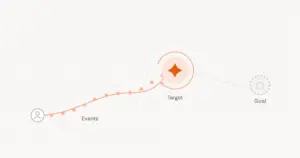
A path of small repeatable steps leading to a one-time goal
Why a one-time goal starves an agent
An agent in Aampe by MoEngage learns from one person at a time. It does something, watches what that person does in the window after, and compares that with what they would likely have done anyway. Every message is a small experiment, and the agent updates its beliefs after each one. That loop needs an outcome that can happen again. Once a user completes a one-time setup, there is nothing left for the agent to cause. Until they complete it, almost every message ends in silence. And silence after one ask says very little about whether a different ask, a week later, would have worked.
Schaun Wheeler made this point about one-time and scheduled target events last year. Our own guide to events turns it into a quick self-check with five questions: can it happen any day, can the same person do it again, is it a choice, does it reflect real use, and does it happen often enough to measure. A one-time setup step fails the second question by definition.
The same problem takes another shape when the outcome repeats but arrives late. Several subscription businesses we work with care most about a conversion that lands a month or more after a message. An agent can respond to what a user does in the days after a message. It can also chase something a month away, but it can’t do both well. A month is long enough for dozens of other things to happen to that user. The delay belongs to the outcome, and any learning system would need leading indicators to work around it.
Build a ladder of leading indicators
The fix is a ladder of repeatable behaviour that tends to come before the big move. We have seen the same need across several customers in different categories, and the ladder we recommend has three rungs.
The first rung is everyday use. A user who keeps returning to core features, like checking a balance or starting a session, is showing a good sign. If the agents learn which messages bring that user back, that’s a better one. These leading indicators can happen any day, for almost anyone, as often as the user likes.
The second rung is content that answers the doubts people have about the big move. Think of step-by-step guides, short explainers, security details and plain comparisons. Engagement with that content is one of the more useful leading indicators. It also teaches the agents which users respond to which doubt. In practice, the team adds a content type component to its message labels. Options might include app features and educational content, and more than two is better.
The third rung is the direct ask itself. It goes mainly to users who have already climbed the first two rungs. Everyone else still hears about it, just much less often. Set up this way, the big move becomes a sensible target, because agents only ask people for whom it is a live question.
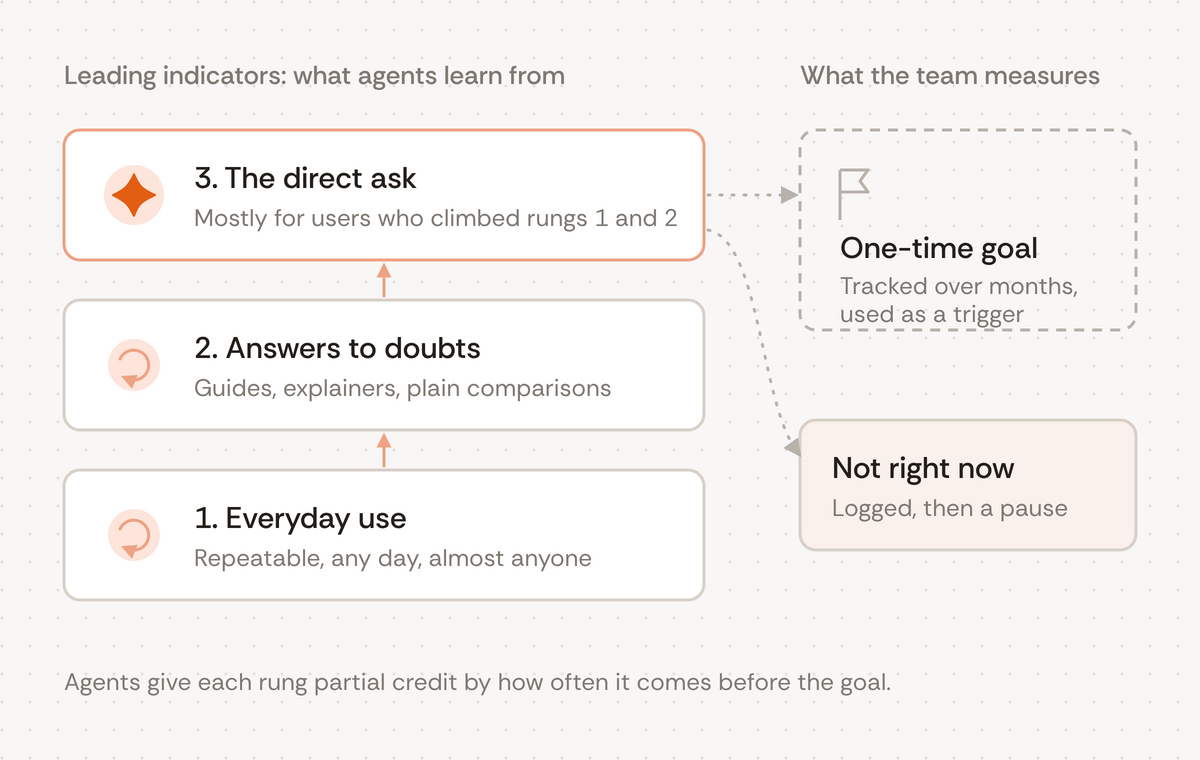
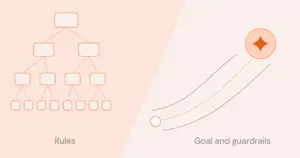
Diagram of leading indicators: three rungs of repeatable actions (everyday use, answers to doubts, the direct ask) leading to a one-time goal the team measures
How agents give partial credit
This works because of how agents grade what follows a message. A reward function names one primary target, or a small number of them. Every other positive event earns partial credit, weighted by how often it has come before a target in the past. Strong leading indicators, the actions that usually precede the big move, count for more than ones that rarely do. The agents work out those weights from the event history. So the weights are only as good as the history is complete, which is one more reason to send the full event stream.
Some teams have already studied which early actions predict the outcome they care about. Those leading indicators are the first candidates for the ladder. Teams without that analysis can start from the event history, which shows which actions tend to come first.
Let people say not now
One more step makes the ladder sharper. When the direct ask goes out, give people a third answer besides yes or silence. It can be as simple as an option that says this isn’t relevant right now. Record that answer as an event and it does two jobs. An eligibility rule can make those users wait before they hear the ask again. It also cleans up the measurement, since success is then counted among people who could say yes.
Measure the goal and aim at the path
None of this means the business stops caring about the big move. It stays on the dashboard, and the moment a user completes it makes a good trigger for a different conversation. Our events guide treats one-off moments as triggers and filters, and keeps them off the list of things to optimise. The agents aim at repeatable leading indicators while the team watches the one-time outcome over months to judge whether the ladder works.
There is a house rule for this: optimise when you get one shot, and align when you get many. The big move is a single shot, while the relationship that leads to it offers many, and that relationship is what agents can learn.
More conversations on how agents learn are on our YouTube channel. One short video covers why not every click counts the same.