In week twelve, the growth team asks the CRM team to start pushing referrals. The agents have spent a quarter learning from purchases. Now the question in the room is whether all of that learning gets thrown out when the reward function changes. The answer depends on what the agents were learning from, and it is wider than the goal event.
What the agent was reading all along
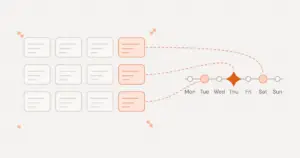
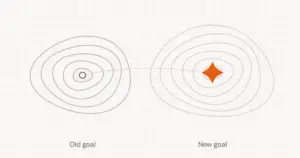
Picture a climber in fog who can read only the height under their feet. The climber has to infer the shape of the land from many such readings. An agent learns about a person the same way, with events as the readings. A reward function sets how much each event counts toward the goal. An add to cart, for example, counts as a share of a cart completion. The agent uses all of those events to build a picture of the person. That picture covers what the person was already doing, what happened after a message arrived and how the response looks over time. No single event carries the whole weight.
A new reward function changes how high each spot reads. How much that matters depends on how far the new goal sits from the old one.
When the new goal sits close to the old one
Moving from cart completion to add to cart is a small step. Both are proxies for company success. They reach it by different routes, so the readings shift a little and the peaks stay roughly where they were. Agent behavior changes less than most teams expect, because most of the picture carries over.
That is also why teams can start simply. Plenty of teams lack the bandwidth to define reward functions carefully at the start. They begin with purchase completion and differentiate later, which is a fine way to begin. It also sets up the harder case, where a later goal sits somewhere else on the map.
When the new goal sits somewhere else
Referring a friend is a different kind of event from buying. Teams that began with purchase completion often add referral messages later. Then they find those messages being judged on whether someone bought, which makes little sense. A new reward function fixes the measurement, because the team can point it at those messages and leave everything else as it was.
Here the readings change a lot, so the agent’s behavior should change too. It handles the shift the way it handles any user whose routine has changed. What counted as success before now looks different. Its confidence in old choices drops, and it goes back toward exploring. The adjustment looks like what happens when a team goes from feeding an agent ten kinds of events to a hundred, because new information arrives and the agent course-corrects.
The test for any system is whether a change of goal forces it to start over. A system that learns only from the goal event has little else to keep. An agent that learns from the whole picture keeps what it knows about each person and adjusts the part the new goal touches.
Back to week twelve, with the growth team’s request on the table. The agents have not lost a quarter of learning. The new reward function gives them a fresh question to ask about people they already know.
This builds on an episode of Agents with Schaun 101, a conversation between Schaun Wheeler, Aampe’s Chief Data Scientist, and Patricia Lazatin. More conversations like this are on our YouTube channel.