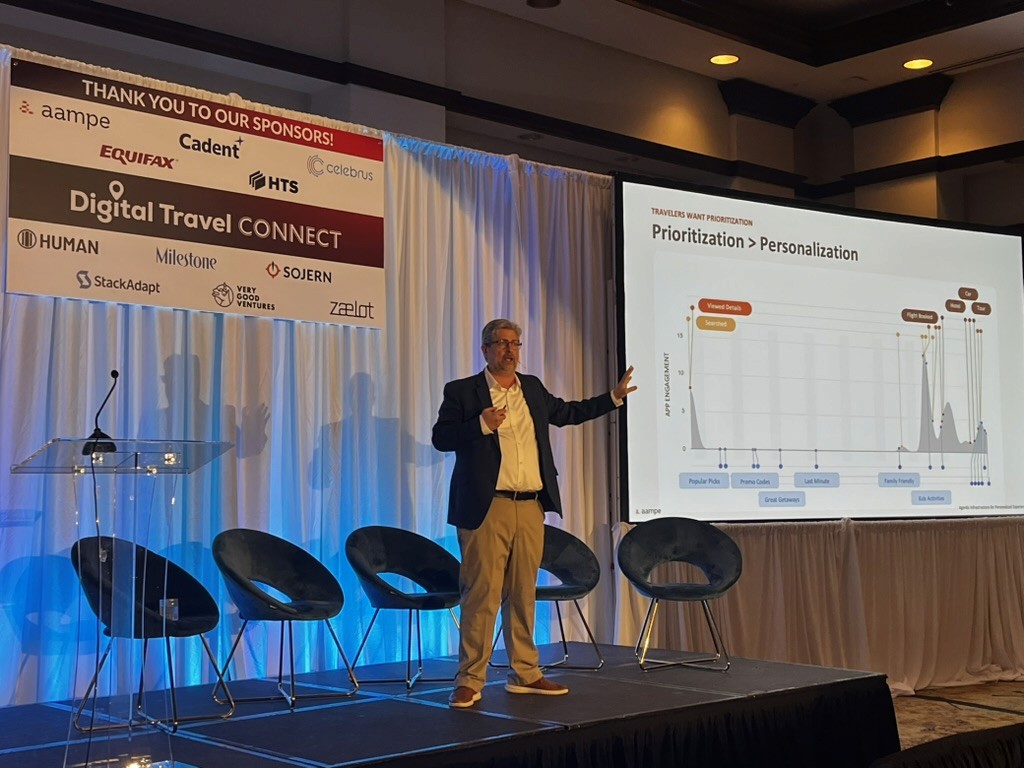
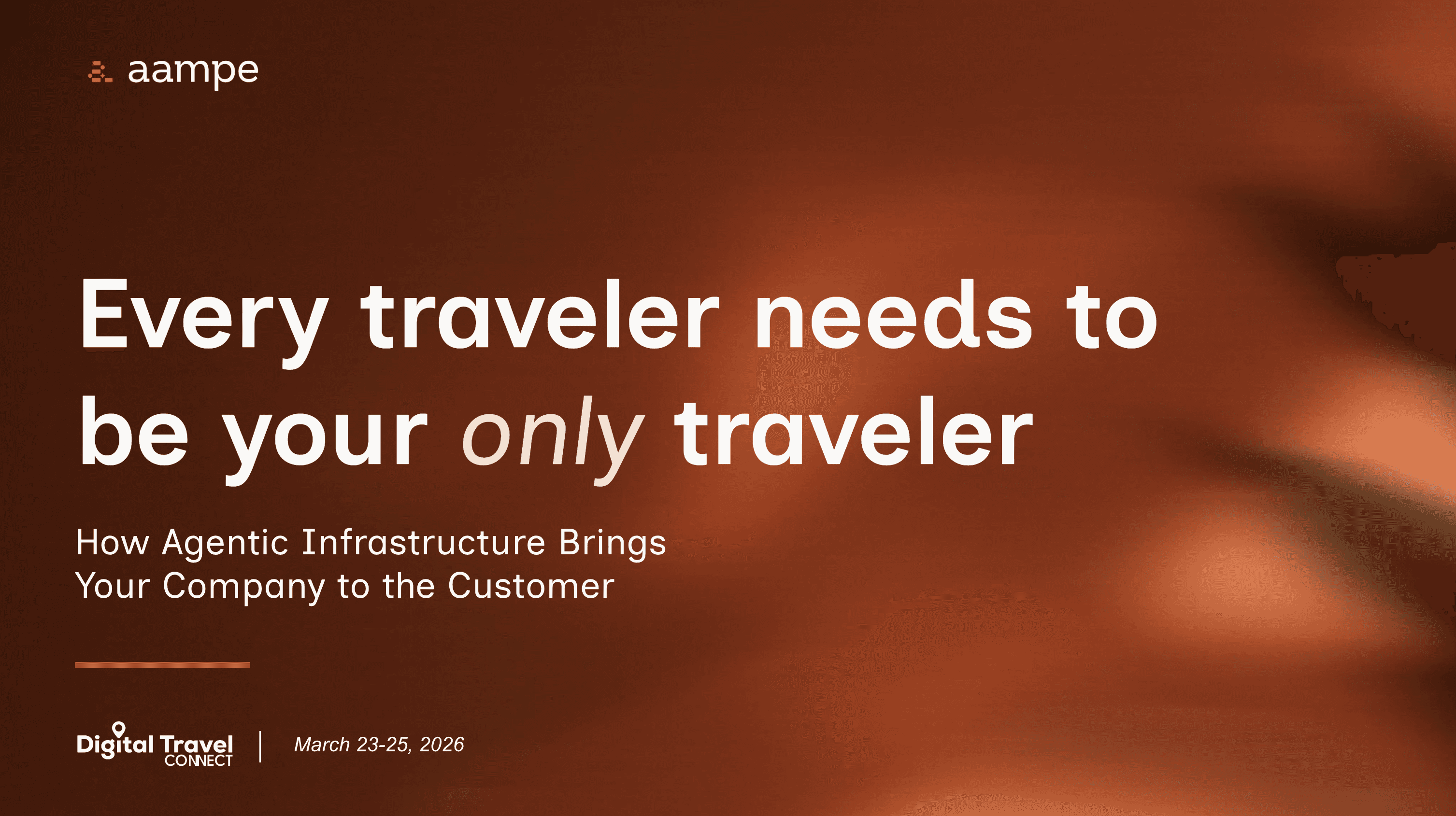
At Digital Travel Connect 2026, Aampe’s Chief Scientist & Co-Founder, Schaun Wheeler, took to the stage to focus on a simple idea with major implications for travel brands: Every traveler needs to feel like your only traveler.
That is a higher bar than just "personalization" as the industry has traditionally defined it. It's not about inserting a first name, picking from a few creative variants, or optimizing a workflow one campaign at a time. It's about building systems that can learn continuously about an individual traveler and adapt the business around them in real time.
The problem with most “AI” in customer engagement
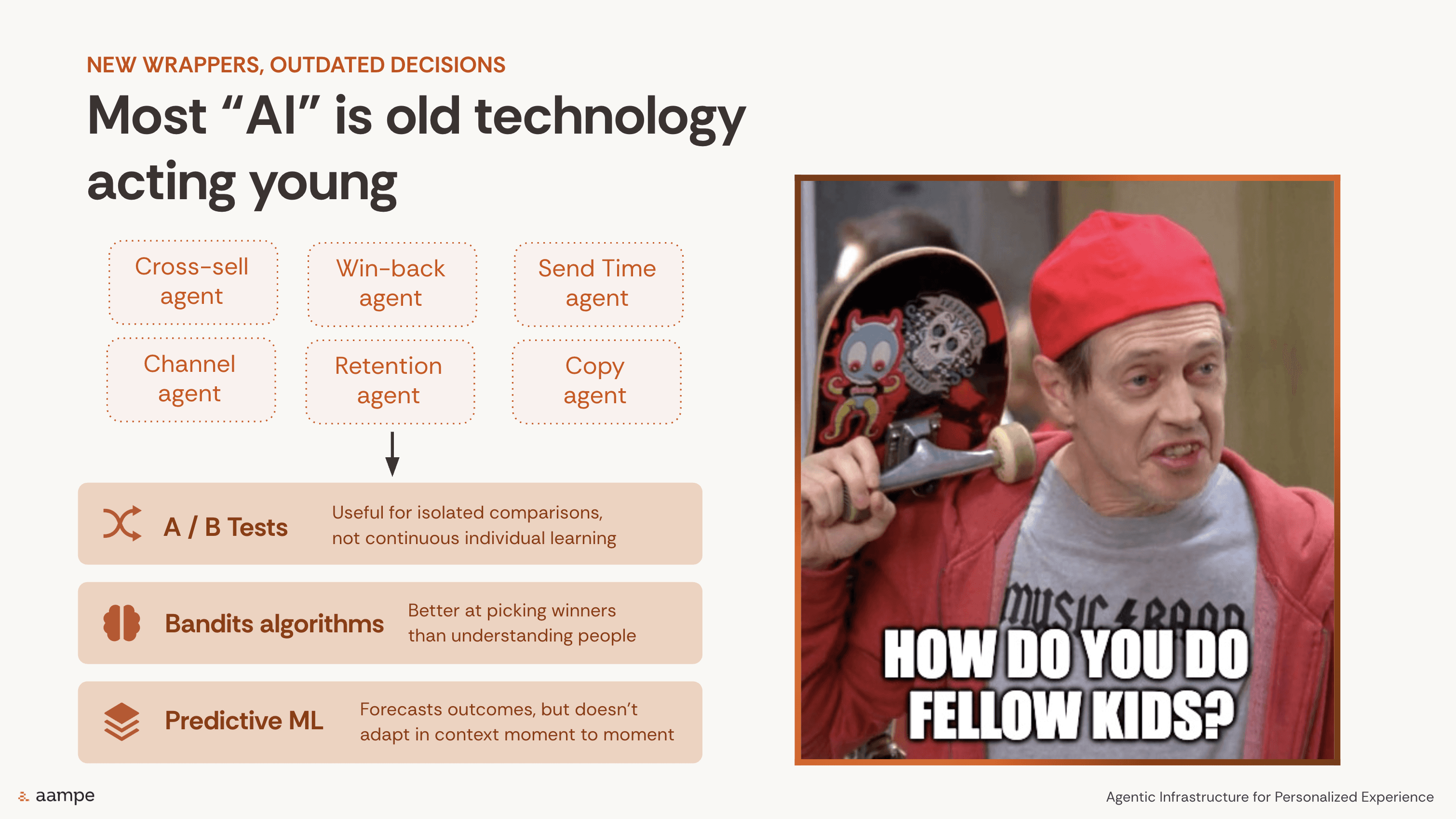
One of the core arguments in the talk was that much of what the market now calls “AI decisioning” is still built on an old foundation.
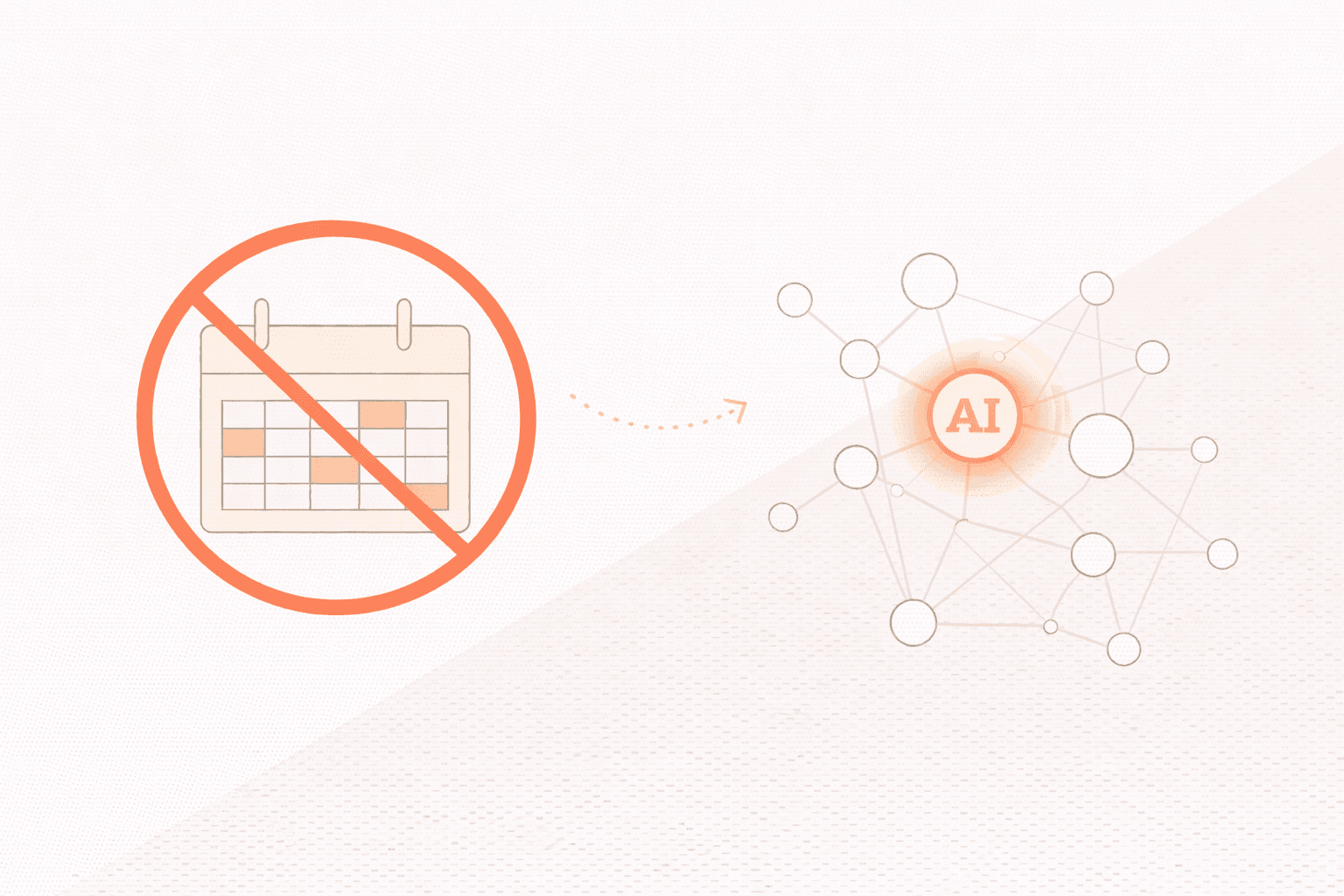
The interfaces may look modern. The components may now include copy agents, channel agents, send-time agents, and cross-sell agents. But the decisioning layer underneath often still depends on familiar tools: A/B tests, bandits, and predictive ML. In isolation, each of those methods has value. But none of them were designed to support continuous, individual-level intelligence. As the deck puts it: most “AI” is still “old technology acting young.”
Why the current stack falls short for travel
Travel is one of the clearest examples of why this matters.
A traveler’s context changes constantly. Intent can shift from dreaming to comparing to booking to planning to returning. One traveler may care most about family-friendly recommendations. Another may be driven by price. Another may respond to practical itinerary content before they respond to any offer at all. Static journeys and campaign workflows are not built for that level of variability.
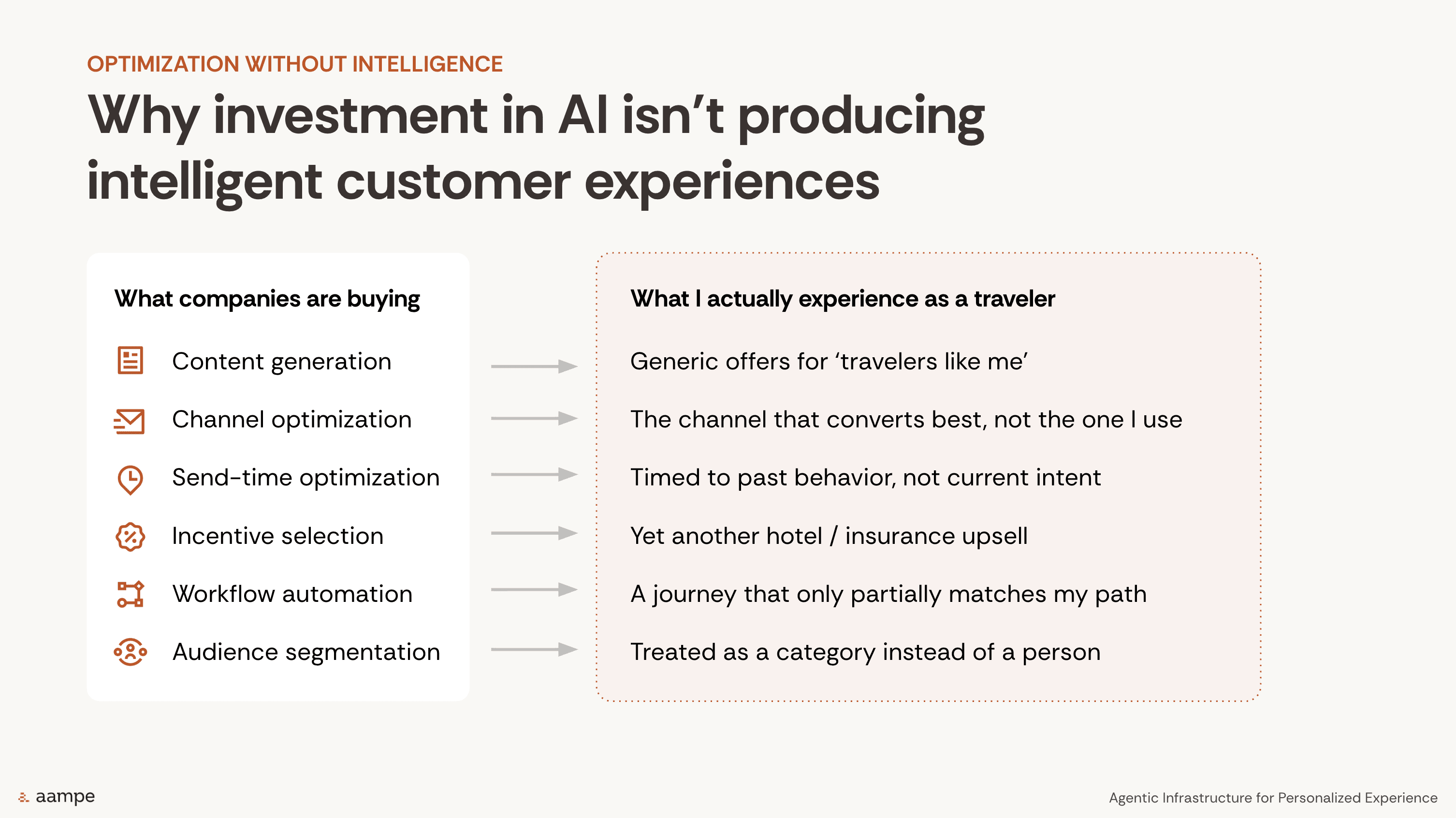
Aampe's session contrasted what companies think they are buying with what travelers actually experience:
content generation becomes generic copy for a segment
channel optimization becomes the channel that converts best, not the one the traveler prefers
send-time optimization reflects past behavior, not current intent
incentive selection becomes another pushy promo
workflow automation becomes a journey that only partially matches the traveler’s path
and segmentation still treats a person as a category instead of an individual
That gap is especially visible in travel, where the same customer can behave like a completely different person depending on trip type, destination, timing, companions, budget, and urgency.
Campaign AI forgets
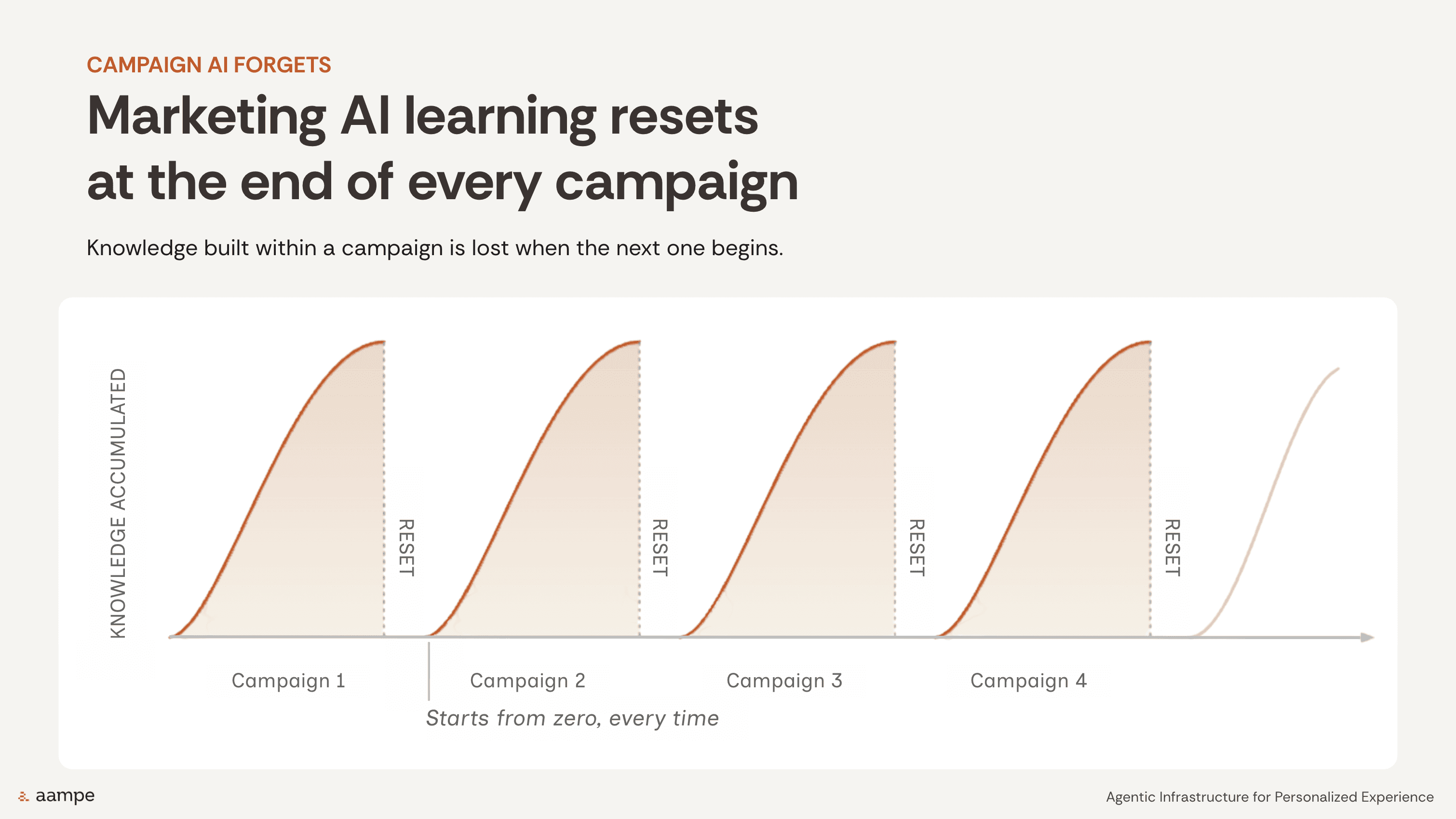
Most marketing AI still learns at the campaign level.
That means the system may improve within one workflow, but when the next campaign starts, the learning effectively resets. Aampe's session visualized this as repeated campaign curves that build knowledge, then drop back to zero, over and over again.
This is one of the central limitations of campaign-scoped AI: it serves the operating model of the business, not the evolving reality of the traveler. A business may see optimization. The traveler experiences repetition.
What changes when learning is built around the traveler
The alternative is not “more workflows.” It is a different architecture.
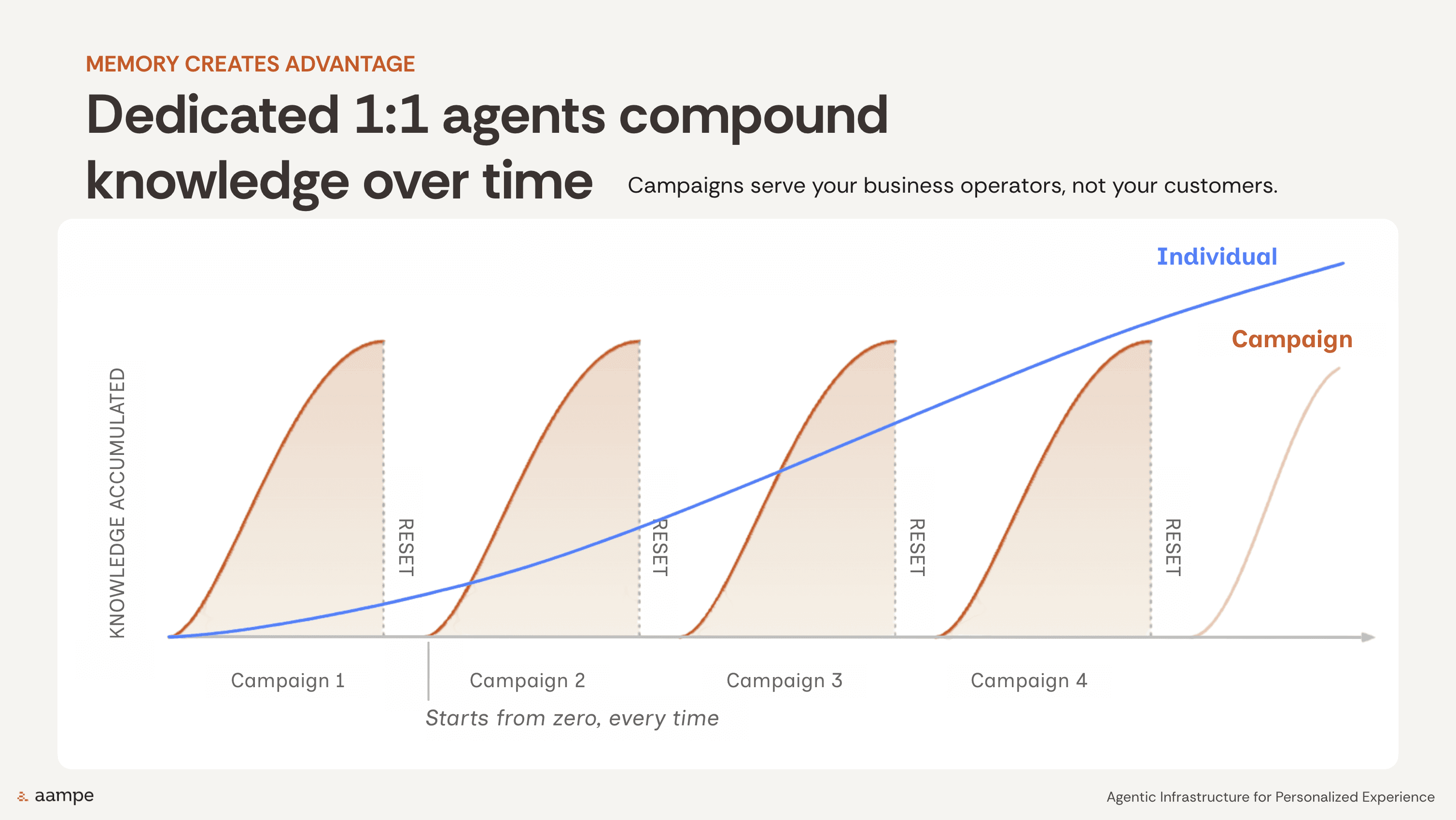
Instead of organizing intelligence around campaigns, Aampe organizes learning around a persistent, individual model. That allows knowledge to compound over time, rather than reset with each new initiative. Schaun described this as the difference between campaign memory and durable 1:1 learning: “Dedicated 1:1 agents compound knowledge over time.”
When a system learns this way, it does not just remember whether a traveler clicked a message. It can accumulate evidence about how that traveler responds to timing, tone, content type, destination, offer framing, and more — and use that growing understanding to choose better next actions.
Prioritization is the new personalization
One of the most important reframes from the session was this:
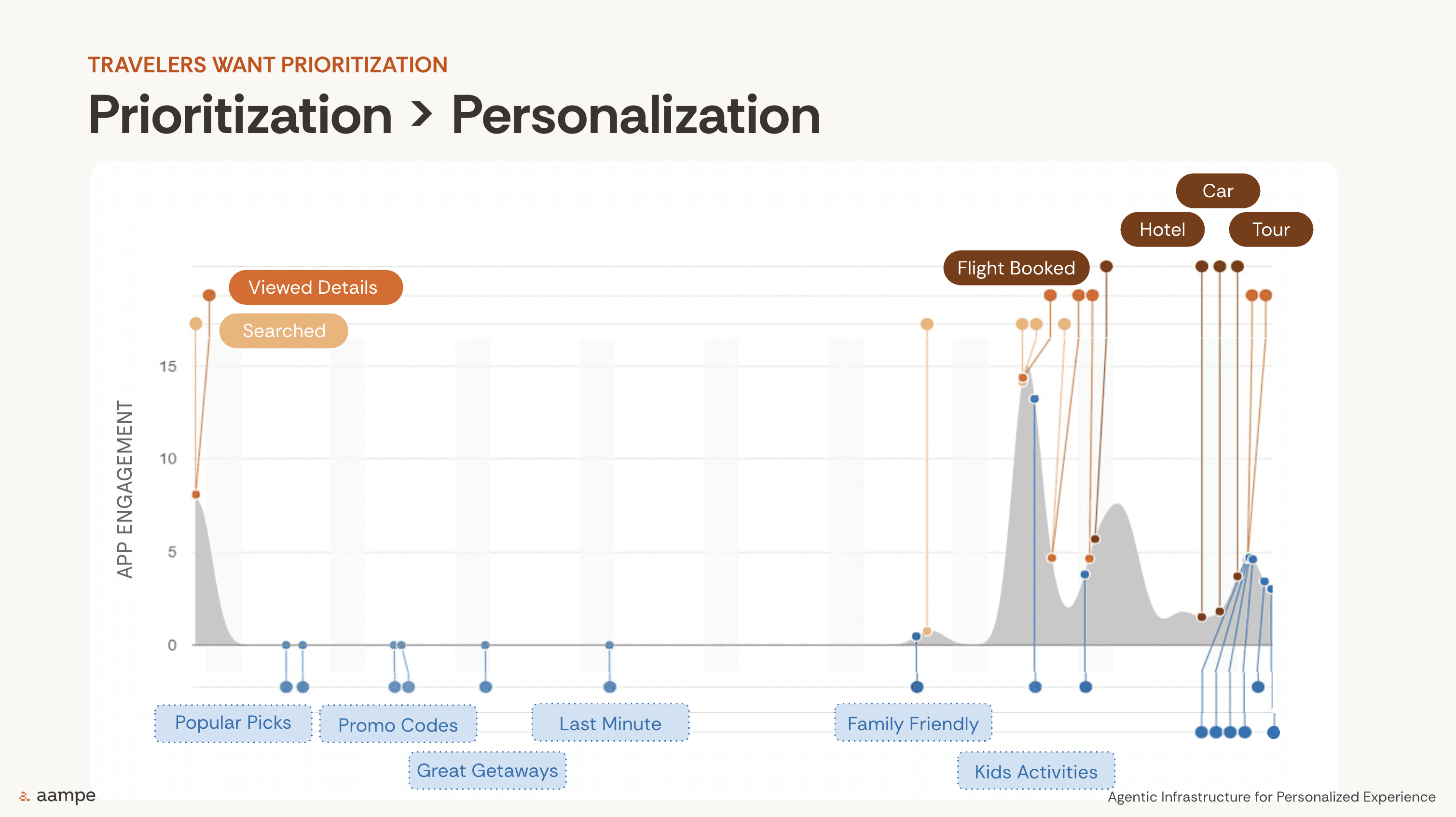
Travelers do not just want personalization. They want prioritization.
That means they want to feel like the brand knows what matters to them right now.
If someone has been researching family travel, the relevant experience is not a generic set of promotions. It might be family-friendly options, kids’ activities, or practical trip-planning content. If someone has already booked a flight, their next-best experience could be a hotel, a car, or a tour — but not all three, and not all at once. The right answer depends on the traveler’s changing context.
This is what makes prioritization fundamentally different from rule-based personalization. Personalization chooses from a predefined menu. Prioritization decides what actually deserves the traveler’s attention.
Travel brands are over-indexed on selling
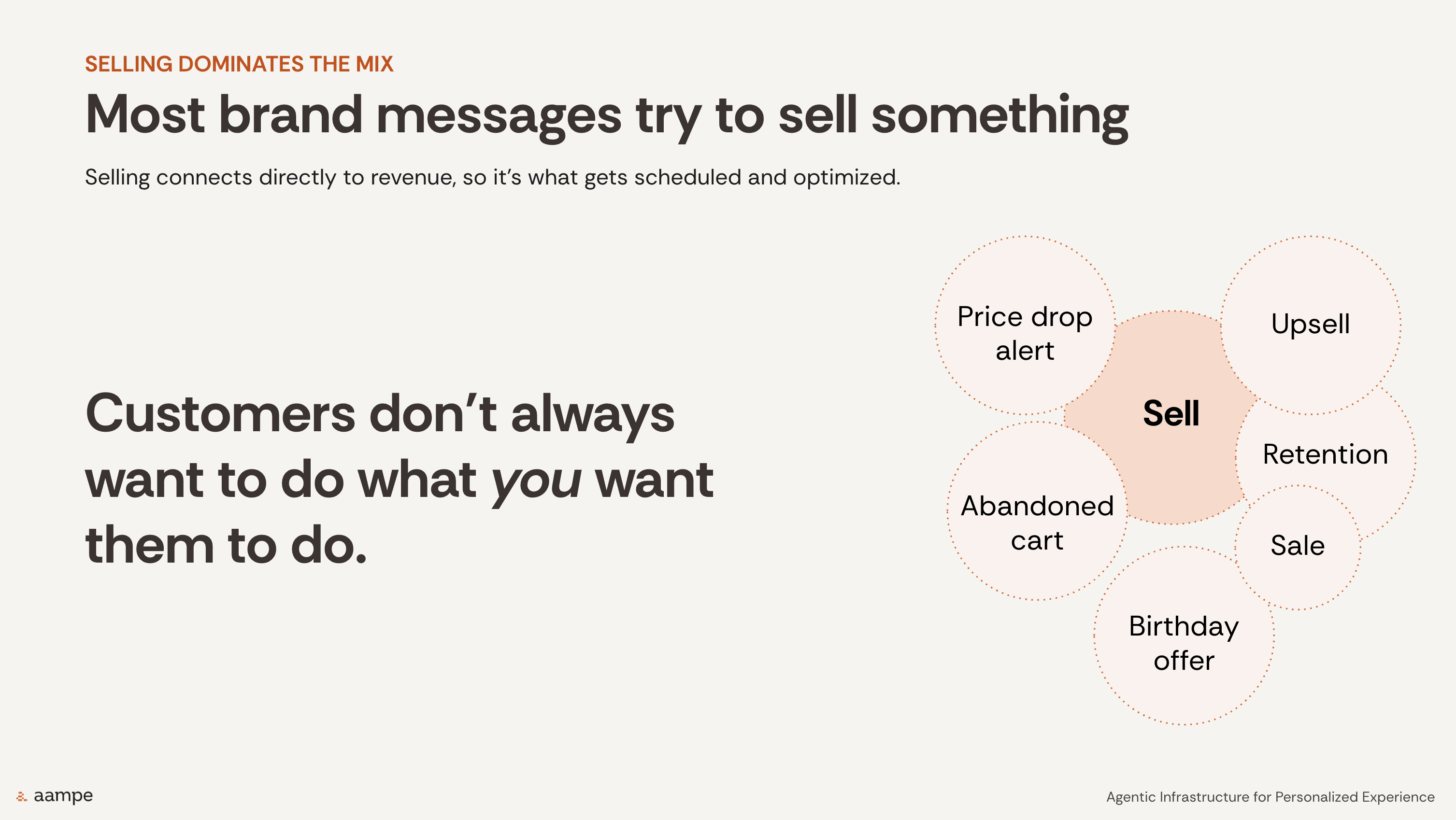
Another theme from the talk: most brand messaging is still dominated by attempts to sell.
That is understandable. Selling is easy to map to revenue, so it is what gets scheduled, measured, and optimized. But it also narrows the system’s ability to learn. The deck makes this point directly: “Selling connects directly to revenue, so it’s what gets scheduled and optimized.”
For travel brands, this often looks like an endless stream of:
book now prompts
upsells
price alerts
promos
retention offers
and win-back messages
The problem is not that these messages are wrong. It is that they are overrepresented. A system cannot learn deeply about a traveler if it is only testing sales pressure.
The hidden asset: you already have more content than you think
A stronger learning system needs more range.
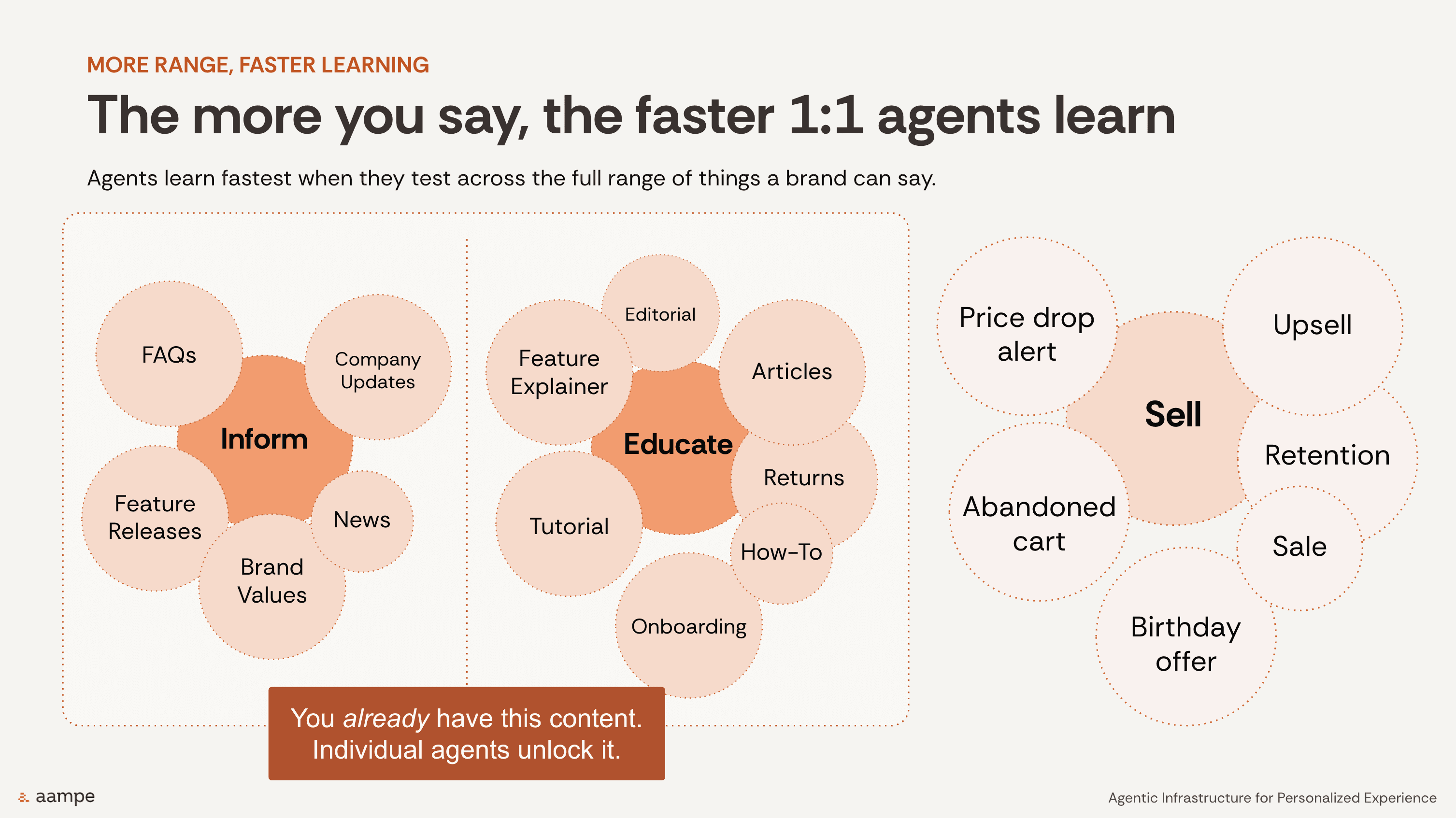
Aampe's session highlighted that agents learn faster when they can test across the full spectrum of what a brand can say — not just commercial offers, but editorial content, educational content, tutorials, onboarding, feature explainers, FAQs, updates, and values-driven content as well.
That is a powerful idea for travel brands, because much of this material already exists:
destination content
travel tips
policy explanations
trip-planning advice
loyalty education
service updates
and product guidance
The missing piece is usually not content creation alone. It is the infrastructure to let individual agents learn from that full range of content over time. As Schaun put it: “You already have this content. Individual agents unlock it.”
Why one traveler gets Bali and another gets Lisbon
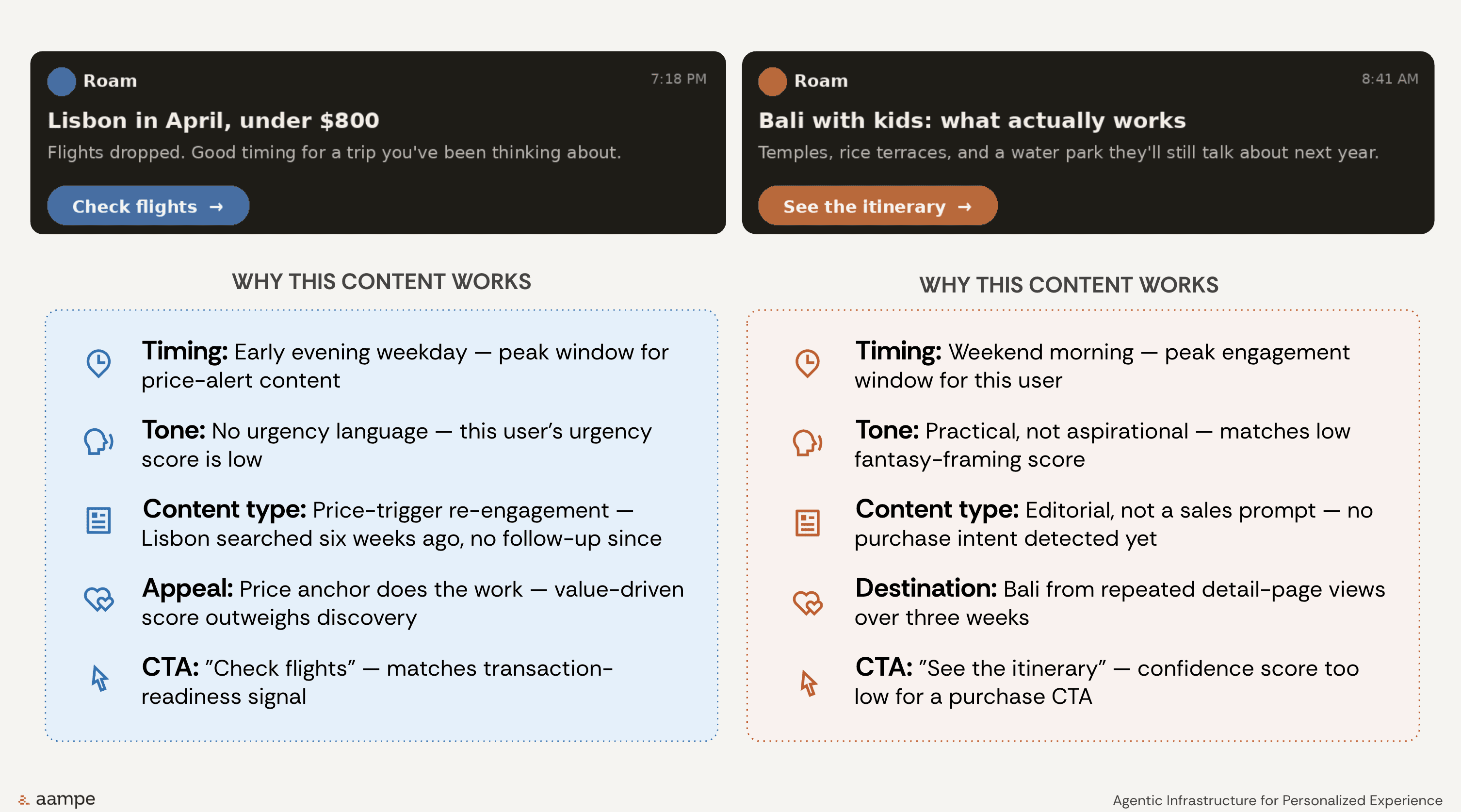
Schaun's session included concrete travel examples to show how 1:1 learning works in practice.
One example surfaced a Bali itinerary message for a user whose behavior suggested editorial, practical planning content would resonate. Another surfaced a Lisbon fare message for a traveler whose signals pointed to price-driven re-engagement. The reasoning behind those messages differed across timing, tone, content type, destination, appeal, and CTA.
That is a crucial distinction. An intelligent system is not just swapping in content. It is assembling a response based on a continuously updated understanding of the person.
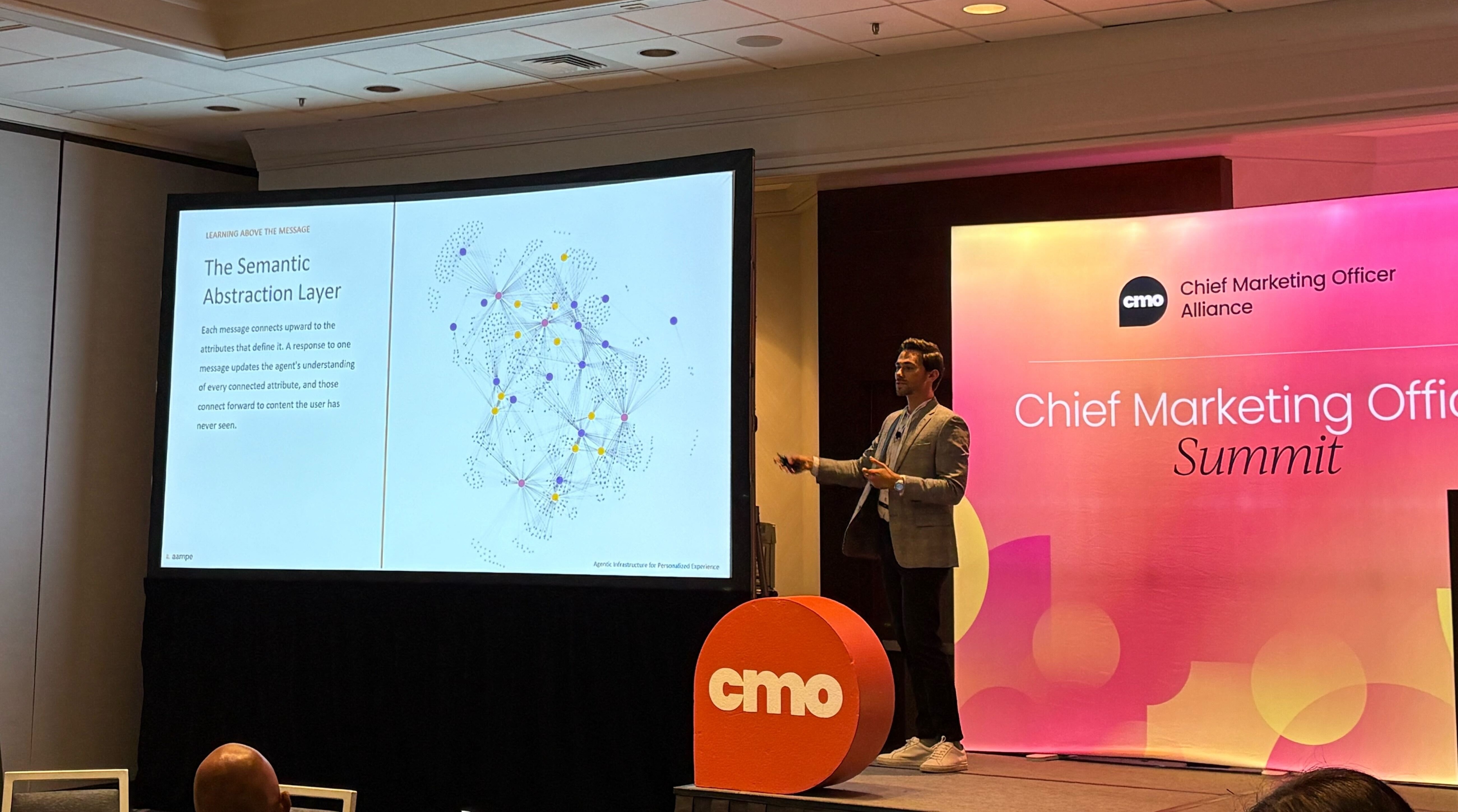
Learning above the message
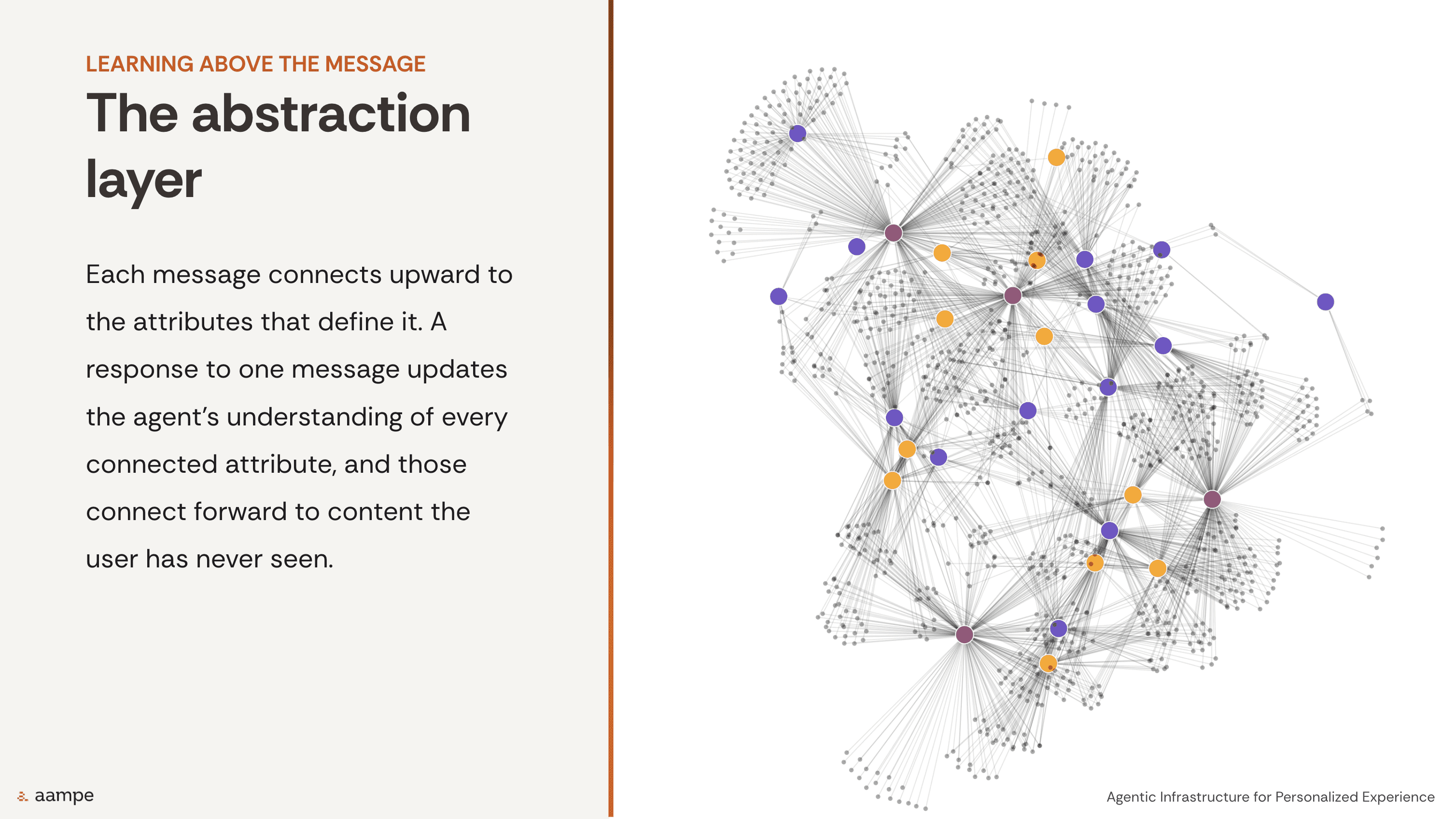
Another important concept from the talk was the “abstraction layer.”
A traveler does not respond to just one isolated piece of content. They respond to the attributes inside it. A message has a tone. A destination. A value proposition. A level of urgency. A format. A CTA. A response to one message updates the system’s understanding of all of those connected attributes — and that learning can then transfer to content the traveler has never seen before.
This is what makes genuine intelligence possible. It is not simply memorizing which campaign performed. It is learning in a way that generalizes.
Confidence matters as much as preference
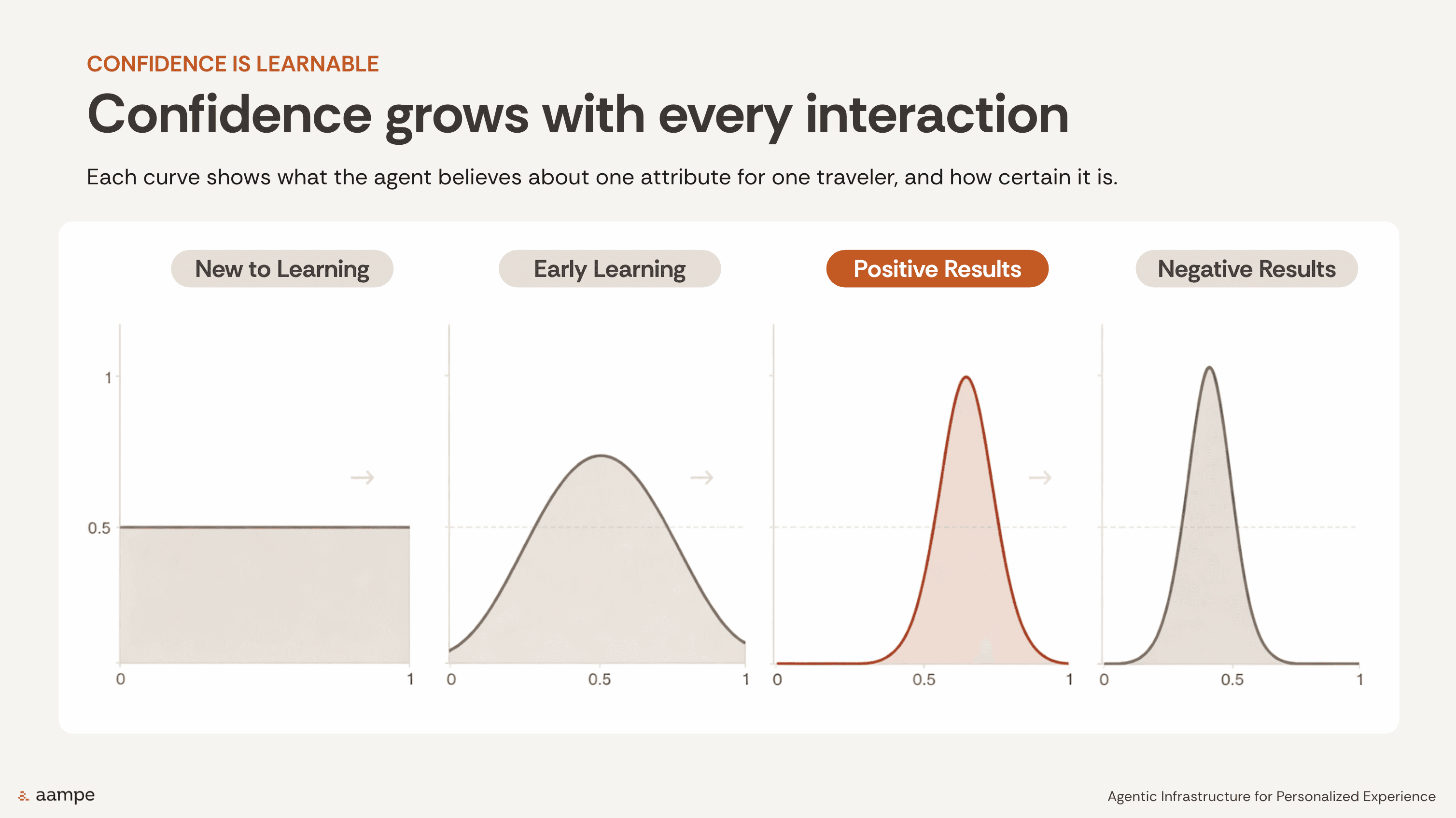
Aampe's session also emphasized that a strong agent architecture does not just estimate what a traveler likes. It also tracks how certain it is.
That confidence grows with every interaction. Early on, the system may know very little. Over time, as it sees positive and negative responses, it sharpens both its expectations and its certainty.
This matters because intelligent systems need to balance exploitation and exploration. They need to act on what they know, while still testing enough to keep learning as the traveler changes.
Every traveler really does differ
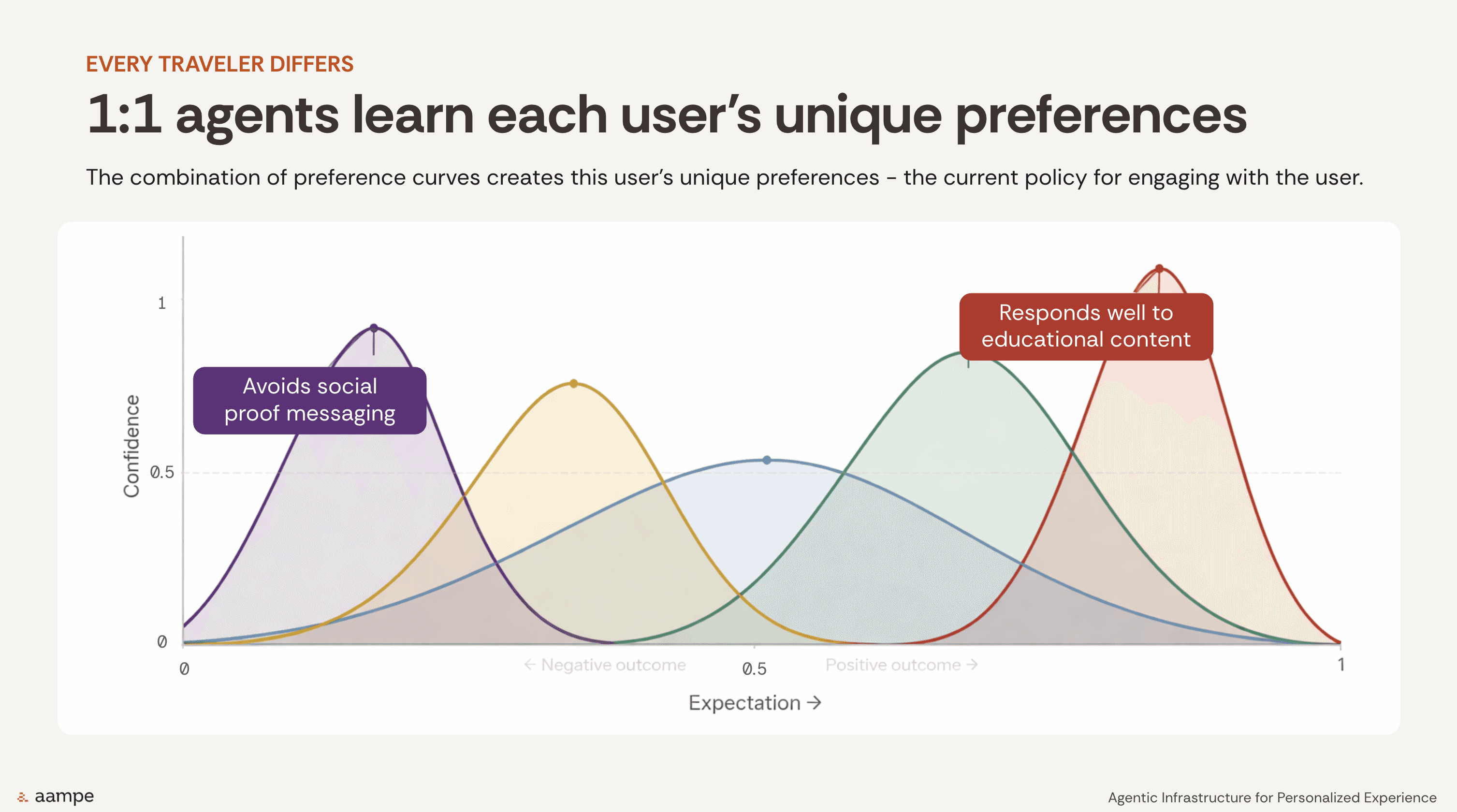
A central message of the presentation was that every traveler’s policy for engagement is unique.
Aampe visualized this as a combination of overlapping preference curves, creating a traveler-specific pattern: one person may avoid social proof, another may respond to educational content, and another may show different preferences entirely. Together, those curves form the current policy for how to engage that individual.
For travel companies, this should feel familiar. A traveler booking a family holiday is not the same as that same person planning a quick city break. A high-value customer is not always a high-intent customer. And a traveler’s current context matters more than the segment they once belonged to.
The model must invert
The presentation closed with the strongest line of the day:
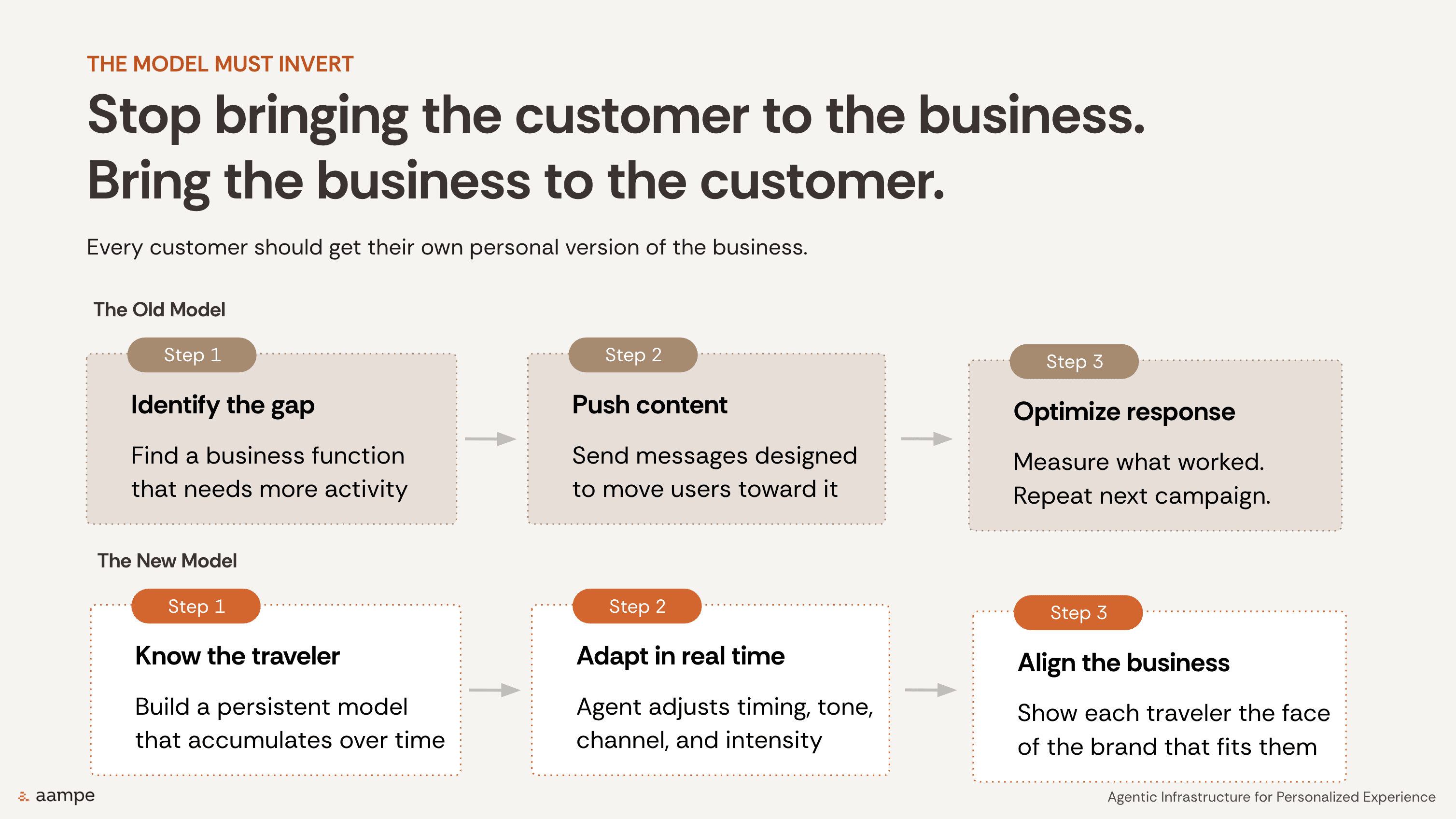
Stop bringing the customer to the business. Bring the business to the customer.
That inversion is the real shift.
The old model works like this:
identify a business function that needs more activity
push content to move users toward it
optimize response and repeat in the next campaign
The new model starts somewhere else:
know the traveler through a persistent model
adapt in real time across timing, tone, channel, and intensity
align the business so each traveler sees the version of the brand that fits them best
That is not a messaging tactic. It is an architectural change.
Final takeaway
The travel industry does not need more AI theater. It needs better infrastructure for intelligence.
If your system only learns within campaigns, it will keep producing campaign-shaped experiences. If it learns around the traveler, it can start to behave in a genuinely adaptive way. That is the difference between optimizing messages and building a customer experience that actually feels intelligent. The talk’s thesis can be summarized in one line from the deck: intelligence is not a capability by itself — it emerges from the connections between capabilities.
And for travel brands, that means the future is not just personalized messaging.
It is a business that can present a different face of itself to each traveler — at the moment that face matters most.
Every traveler wants to feel like your most important traveler. That takes more than better workflows or better prompts — it takes infrastructure built to learn at the individual level. If you want to explore what that could look like for your business, book a demo and we’ll walk you through it.